My partner and I landed in Pudong on a red-eye from Hanoi, checked into a hotel off East Nanjing Road and slept like the dead. I woke up hungry. So did my partner.
This should have been the easy part. Food delivery in China is magic. A rider on an e-bike will bring you hand-pulled noodles, a bubble tea and a bag of fried dough at any hour, often in under half an hour, for less than a sandwich costs at home. Everyone does it.
There's one catch. Every bit of it lives inside an app, and every app is in Chinese.
Night one
A 403, a dead Translate button and a rainstorm
Alipay is the app every visitor sets up, and to its credit, it tries. It has an English mode, an "Easy Go" home screen for visitors and a little Translate button floating in the corner. Meituan, the big delivery app, lives right inside it. I opened it, ready to order.
It wouldn't load. Every restaurant, every category, the same cryptic message: 403. No explanation, in any language.
My partner tried on the other phone. That one loaded. Every menu, every price, every review. All in Chinese, and the Translate button did nothing at all.
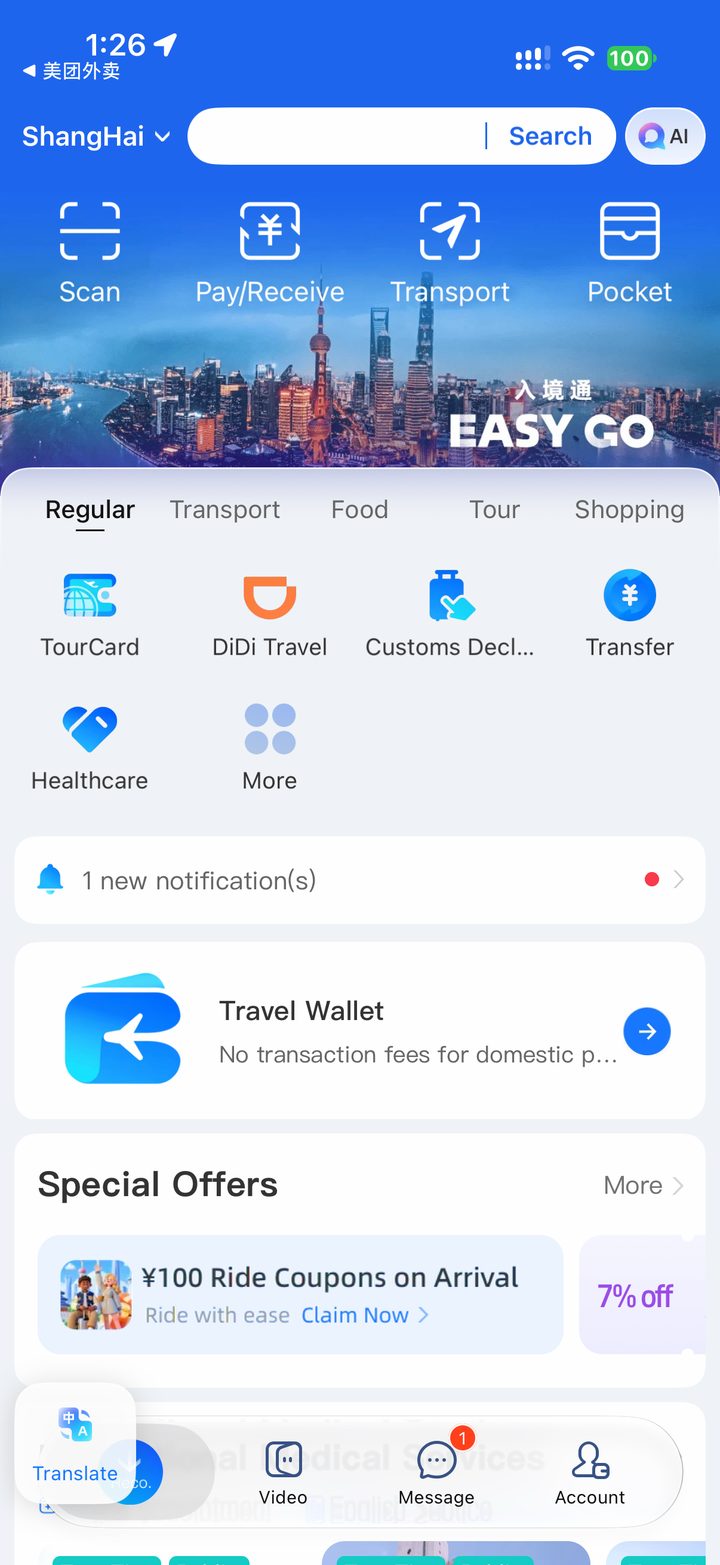
Alipay, for visitors
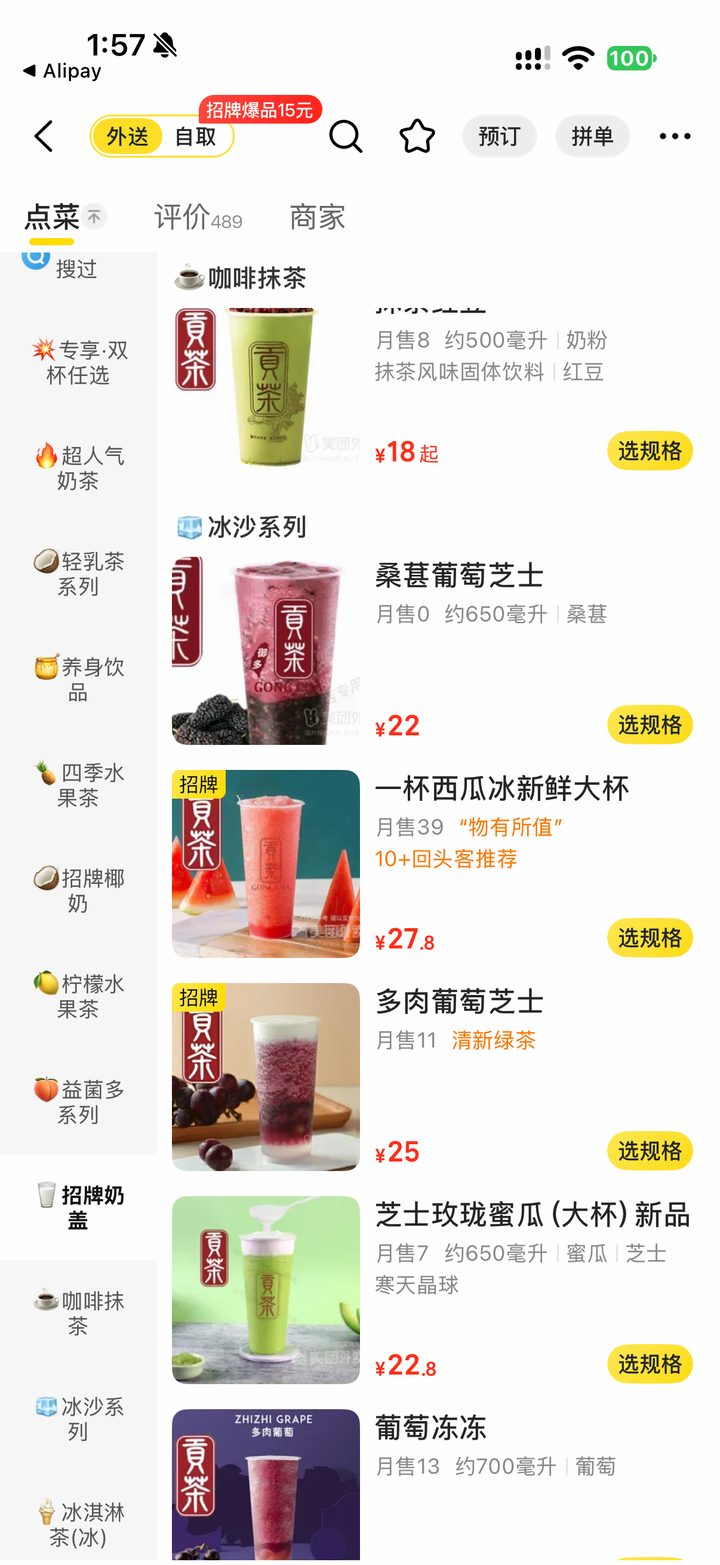
One tap later
What I only worked out later: Alipay's English stops at Alipay. Each merchant inside it runs its own "mini program", and the mini programs couldn't care less about your language setting. The Translate button does work. Sometimes. On some screens, some of the time, for reasons unknown to science. Same screen, two minutes later, nothing. Or poetry. What magic makes it work is a mystery known only to the button itself.
We spent over an hour on it. VPN on. VPN off. A different VPN. Hotel Wi-Fi. No Wi-Fi. Roaming SIM one. Roaming SIM two. Log out, log in, reinstall, change the region, change the language, restart one phone, restart the other phone. At one point I was seriously weighing whether a carrier pigeon could get an order to the kitchen faster. The pigeon would at least have read the menu. Somewhere in there I stopped being hungry and became properly hangry.
I'm told I explained to the Translate button, out loud and in English, exactly what I thought of it. It did not translate that either. I accused a VPN of having something personal against me. I announced I was flying back to Hanoi, where people at least understood what I wanted. At some point I was holding both phones and glaring at them like they owed me money. My partner quietly put on shoes.
So we gave up and went out. In the rain.
The entire point of food delivery is that you don't go out in the rain. That's the product. And there I was, walking through the rain, with two phones full of delivery apps in my pocket, to go and fetch dinner myself like it was 1995.
And this was China. The country where food arrives by drone. Where little robots ride the hotel lift to bring you a towel. And here was I, a tech CEO and CTO with a background in AI and robotics, being denied the use of an app. By a three-digit error code. My professional pride took a bigger hit than my stomach.
We went to one of our favourite noodle spots. The noodles were delicious. Hot, slurpy, exactly right. Which somehow made it worse. The food had been ten minutes away the whole time. It just refused to come to me.
Night one: Shanghai 1, me 0. Damp, but well fed.
Night two
Dumplings by screenshot
The next night, somewhere around 1 a.m., the hunger came back. Same stomach, same city, same phone. But this time I had a theory. The system works. Millions of people order through it every hour. Grandmothers order through it. Teenagers order through it while ordering something else through it. It just didn't work for me. So the problem wasn't China. The problem was my way in.
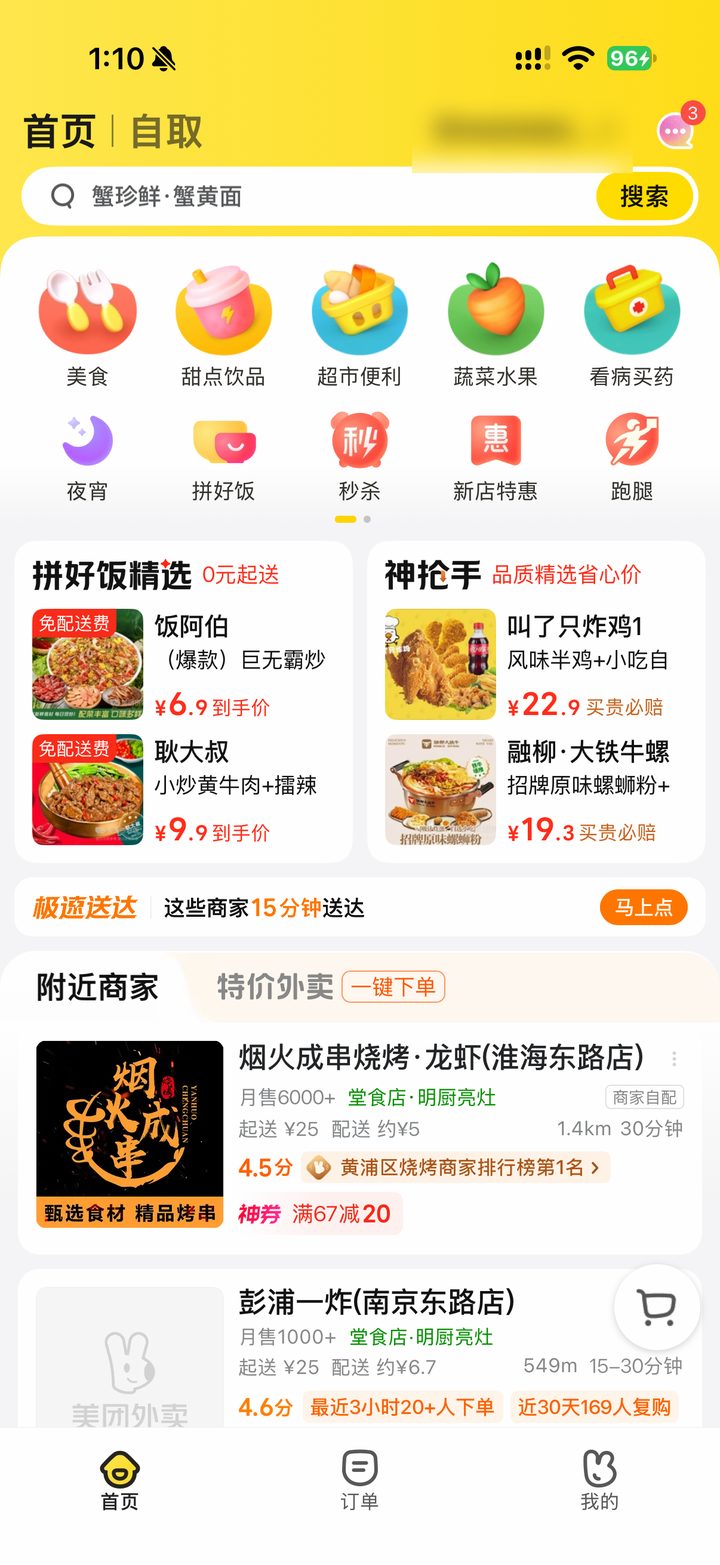
We were both determined this time. I skipped Alipay and installed the Meituan app itself. It loaded. First try. No 403. I nearly cried. Then I actually looked at it. Red price tags. Coupons. Countdown timers. Badges. Characters the size of ants, all shouting at once. It looked like a casino had exploded inside my phone.
My partner, meanwhile, found a mini program inside Alipay that actually translated. It was called, and I promise I'm not making this up, "Takeout". Of course it was. The night before we had thrown VPNs, Wi-Fi, two roaming SIMs and very nearly a pigeon at this problem, and the answer was hiding behind the most obvious word in the English language. It's like searching a whole city for a good restaurant and finding it's called Restaurant.
My side was the least efficient ordering process in human history. Screenshot. Switch to Google Translate. Import the screenshot. Wait. Read a translation that may or may not be about food. Switch back. Find the button I think it meant. Tap. A pop-up. Screenshot again. Every option sheet, every "are you sure?", every coupon, every cheerful little banner. Each one a fresh round trip.
At one point I spent five minutes carefully translating a pop-up. It wanted me to rate the app. Every tap was a gamble. Add to cart? Or subscribe to monthly durian? Now and then my partner asked how it was going. "Great," I said, in the voice of a man defusing a bomb.
An hour and a half later, we had each placed an order. Ninety minutes. There is a lane about 1.5 km from our hotel with good restaurants that are open all night. We could have walked there, eaten, walked back and been asleep. We didn't. Partly because we were tired. Partly because we were lazy. Mostly because by then it wasn't about food any more. The apps had made it personal, and we wanted to win.
Then the little scooter icons set off across the map, and I watched them like the last minute of a World Cup final.
Which brought us to a problem nobody had warned us about: actually getting the food. Riders don't come up to the rooms. Somewhere in the building, our dinner was waiting for us. Where? Neither app said. And the moment we stepped out of the lift, translation stopped working again. Of course it did.
But I had a secret advantage. I know this hotel. We have stayed here every single time we've been to Shanghai for the last ten years. It used to be a Sofitel. Now it's a Radisson. Same building, same lifts, same carpet, new name on the door. I know which lift is slow. I know where the good breakfast table is. If any foreigner in Shanghai was qualified to find a bag of dumplings in this lobby at 1 a.m., it was me.
So I followed a hunch and walked straight to the front door, like a man who knew exactly what he was doing. And there it was. A sign. Right by the door. It might have said "delivery pickup". It might have said "staff only". It might have been a poem. I couldn't read a word of it, but I chose to believe in it. Ten years of loyalty, and the hotel finally paid me back.
My partner was impressed. I did not mention that it was mostly luck.
Next to the sign was a shelf. On it sat a little row of delivery bags, looking about as lost as we were, quietly hoping to be adopted by someone.
One of them had no slip at all. No receipt, no number, no name. Just a bag. An orphan. Whose was it? Could it be ours? There was only one way to find out, so we did what any responsible adults would do at 1 a.m. We looked around the empty lobby, and we opened it. Just a peek. Purely for research.
It was not our dinner. I have no idea whose dinner it was. I folded the top back down very neatly, as if that would erase the crime, and we stepped away from the shelf like two people who had absolutely not just looked inside a stranger's food. Somewhere in that hotel, someone is still wondering why their bag felt slightly opened.
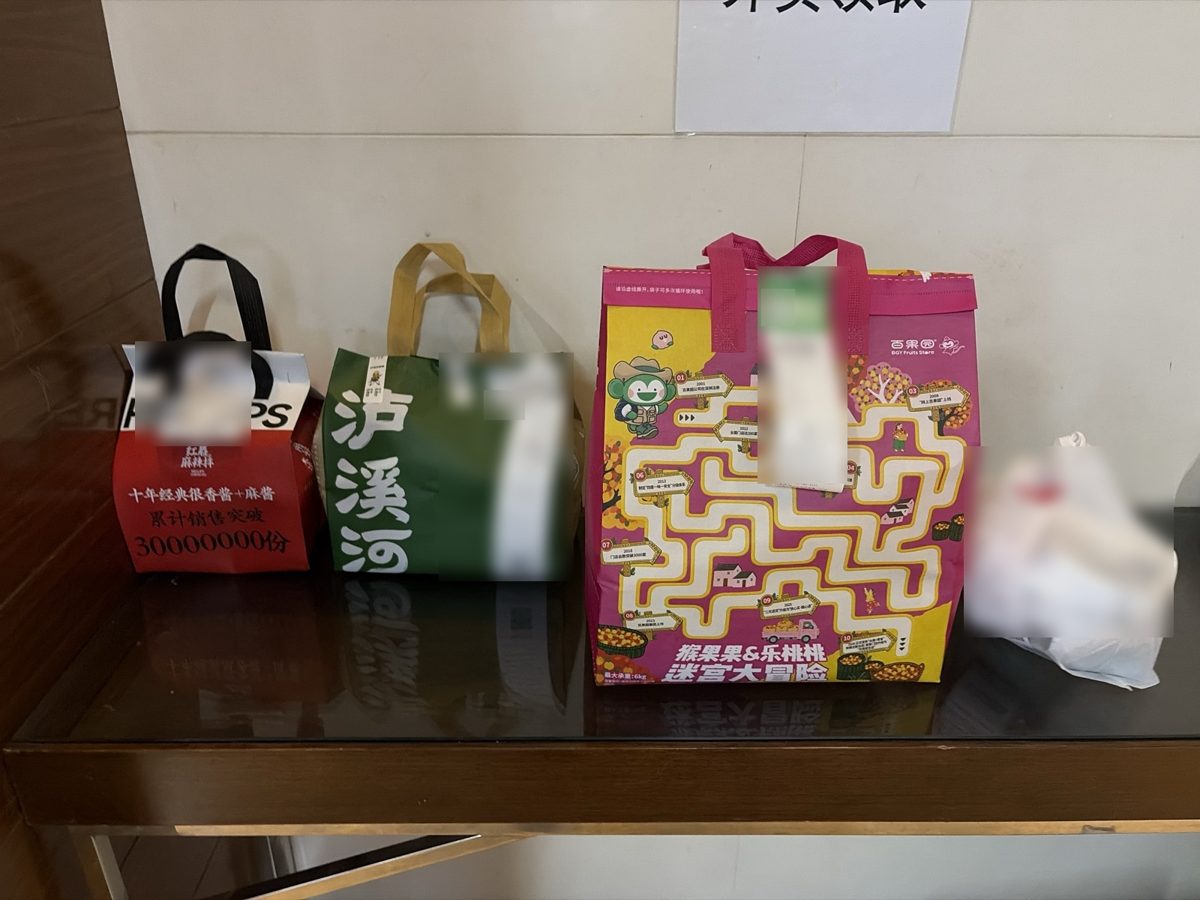
In the end we did it the old-fashioned way. We held our phones up next to the receipts on each bag and compared what looked like order numbers, character by character, like two very tired detectives.
No. Not that. Definitely that… Nope. Maybe? YES!!!
Inside: a box of simple jiaozi, plain boiled pork dumplings. Nothing fancy. They were glorious. I have eaten in some very nice restaurants, and none of them tasted like those dumplings at 1 a.m. Shanghai 1, me 1. A draw, earned the hard way. It felt like winning the World Cup.
Night three
The ¥54 bubble tea that never came
Feeling confident, the next evening I ordered tea. Two from Lelecha, a black grape and a strawberry peach, through Alipay. And this time the translation worked. Every screen, every button. I read that menu like a local. ¥54, paid at 21:28. At 22:06 the app said 已送达: delivered. For about a minute, I was a man who had conquered China.
I went down to the shelf. Nothing. I went down again. Nothing. On the third trip I checked behind the shelf, under the shelf and inside other people's bags. (With my eyes only. I'd learned my lesson.) Nothing.
Somewhere in Shanghai, a parallel universe was enjoying a black grape tea. Or a small black hole had opened up next to the lobby and developed a taste for strawberry peach. Either way, someone was drinking our tea, and it wasn't us.
Side note: as I write this, a bag of three drinks has been sitting on that same shelf for three days. Nobody has come for it. The ice gave up long ago. Every time we walk past, we give it a small nod. We feel your pain, fellow traveller. We don't know where ours went either.
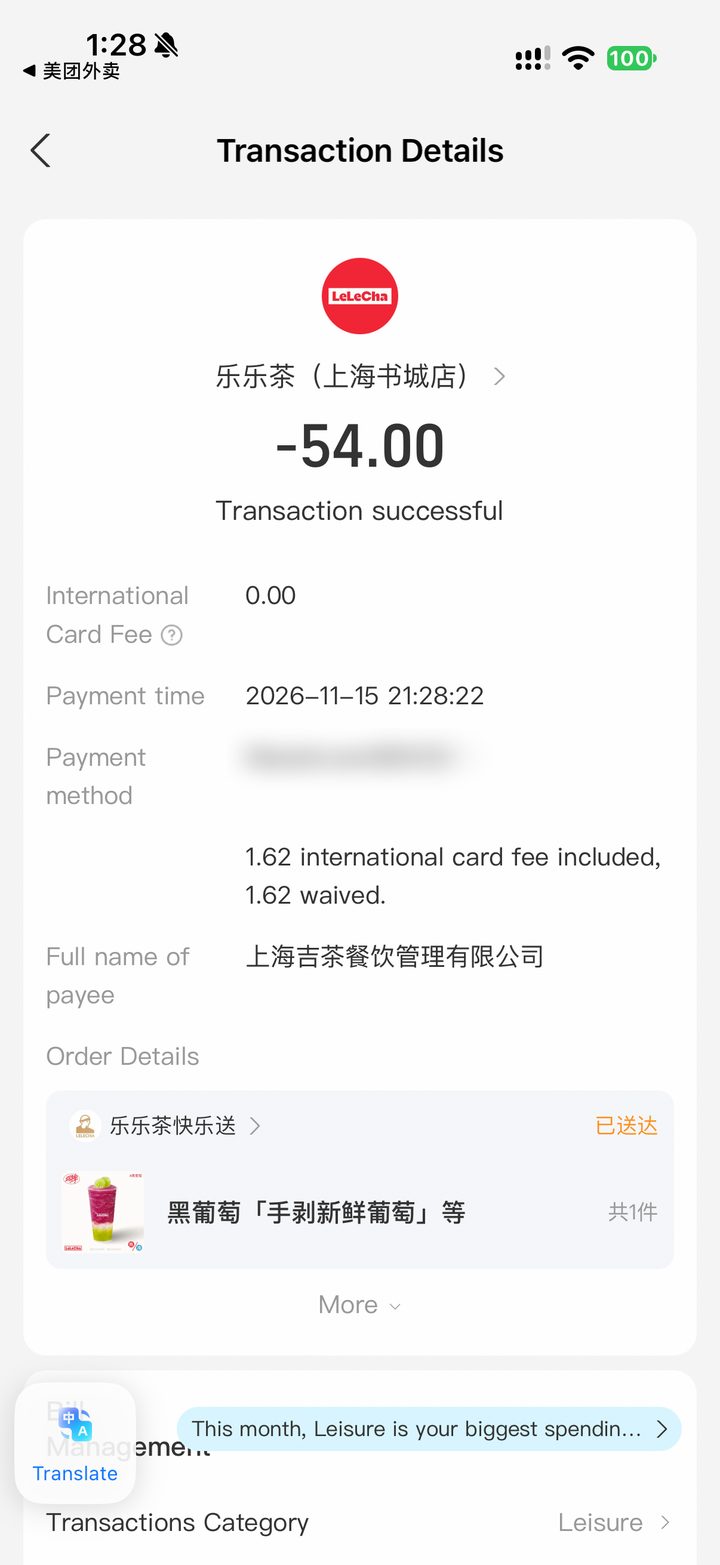
"Transaction successful"
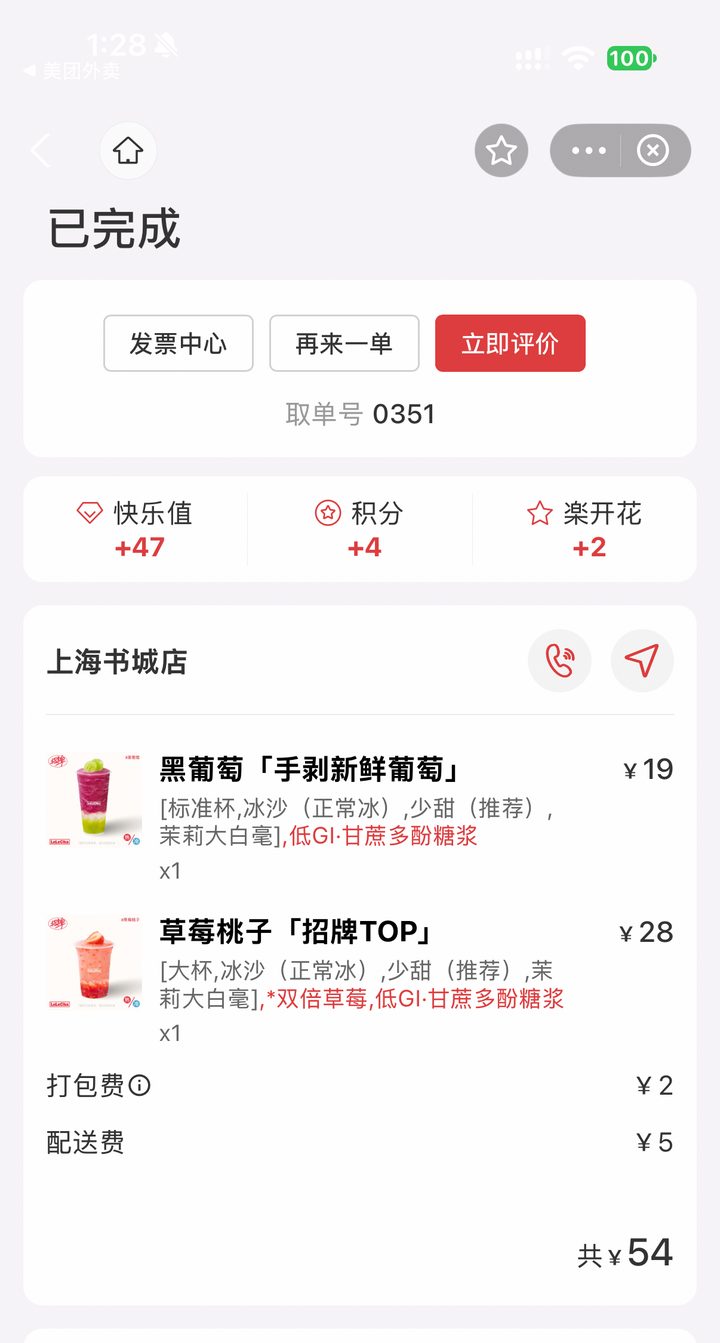
"已完成", completed
So I tried to get help, and this is where it stopped being funny. Alipay's support is a chatbot. It's polite, it's quick, and it answered in perfect Chinese with a cheerful money-bag emoji. When I asked in English, it switched, kindly, and then told me Alipay can't refund the order and can't make the merchant do it either. Call the merchant, it said. Here's the number.
I don't speak Chinese. That's the whole problem. I said so.
Use the in-app chat with the merchant, it suggested. There isn't one. "Contact merchant" opens a phone call. The tea shop's own customer service button opens a phone call. The order page has three buttons: invoice, reorder and rate. No chat, no refund.
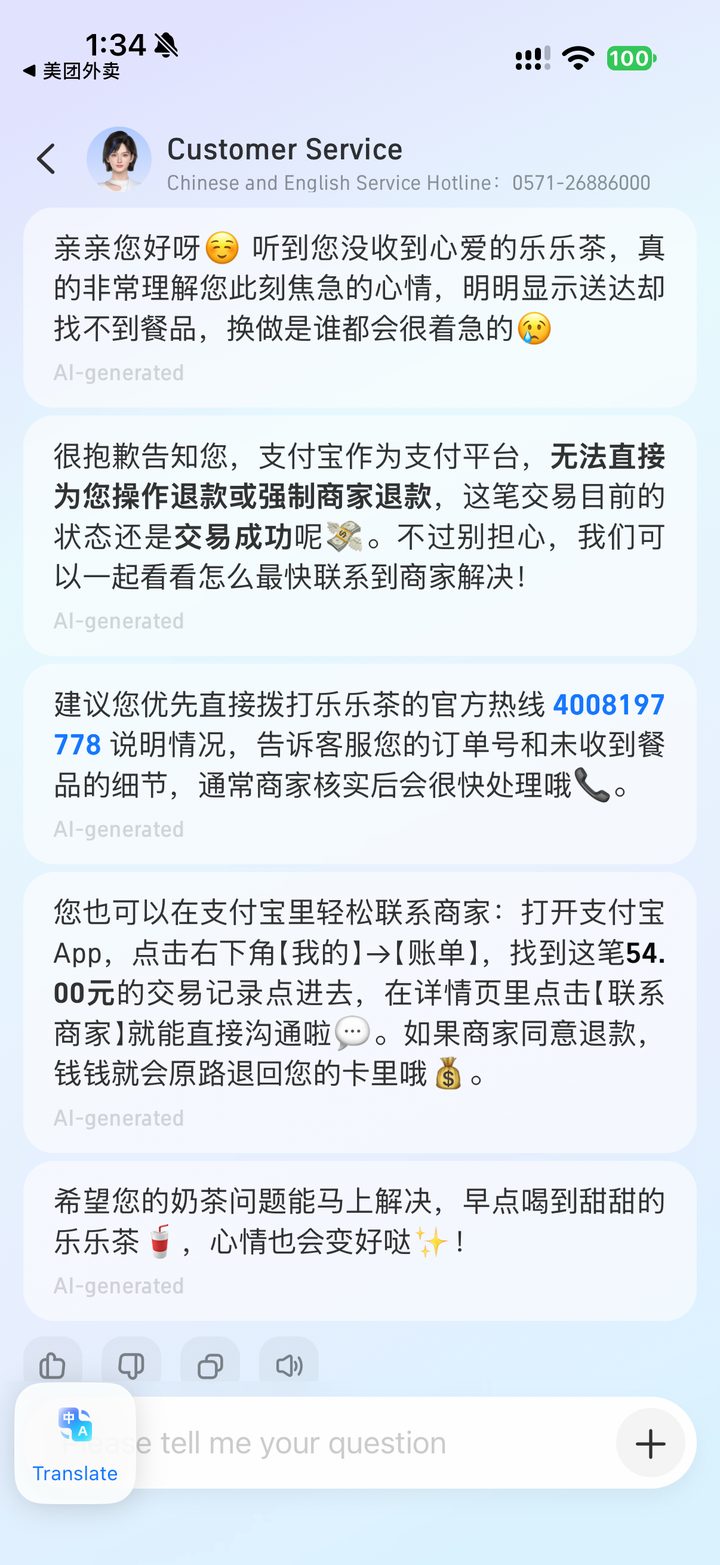
”We can't refund”
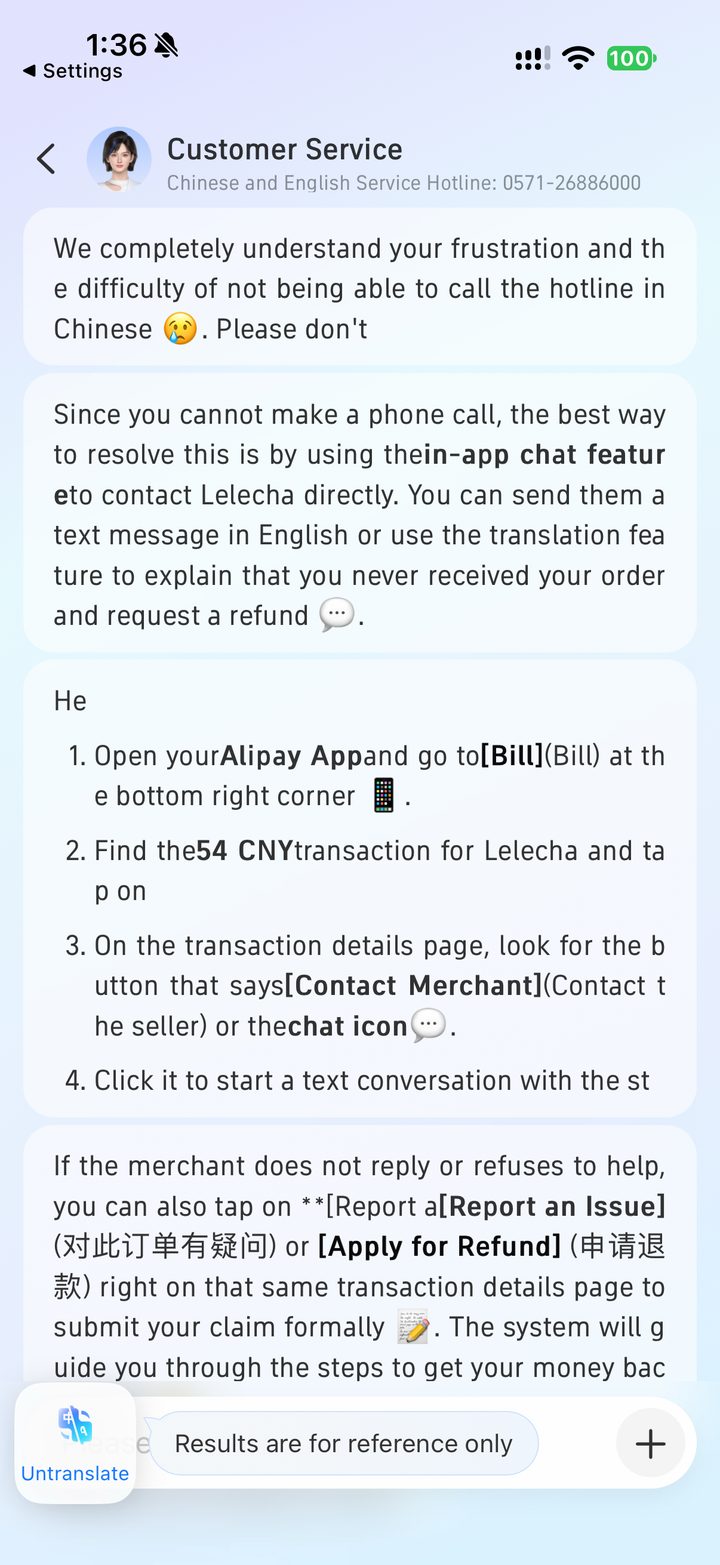
"Use the chat"
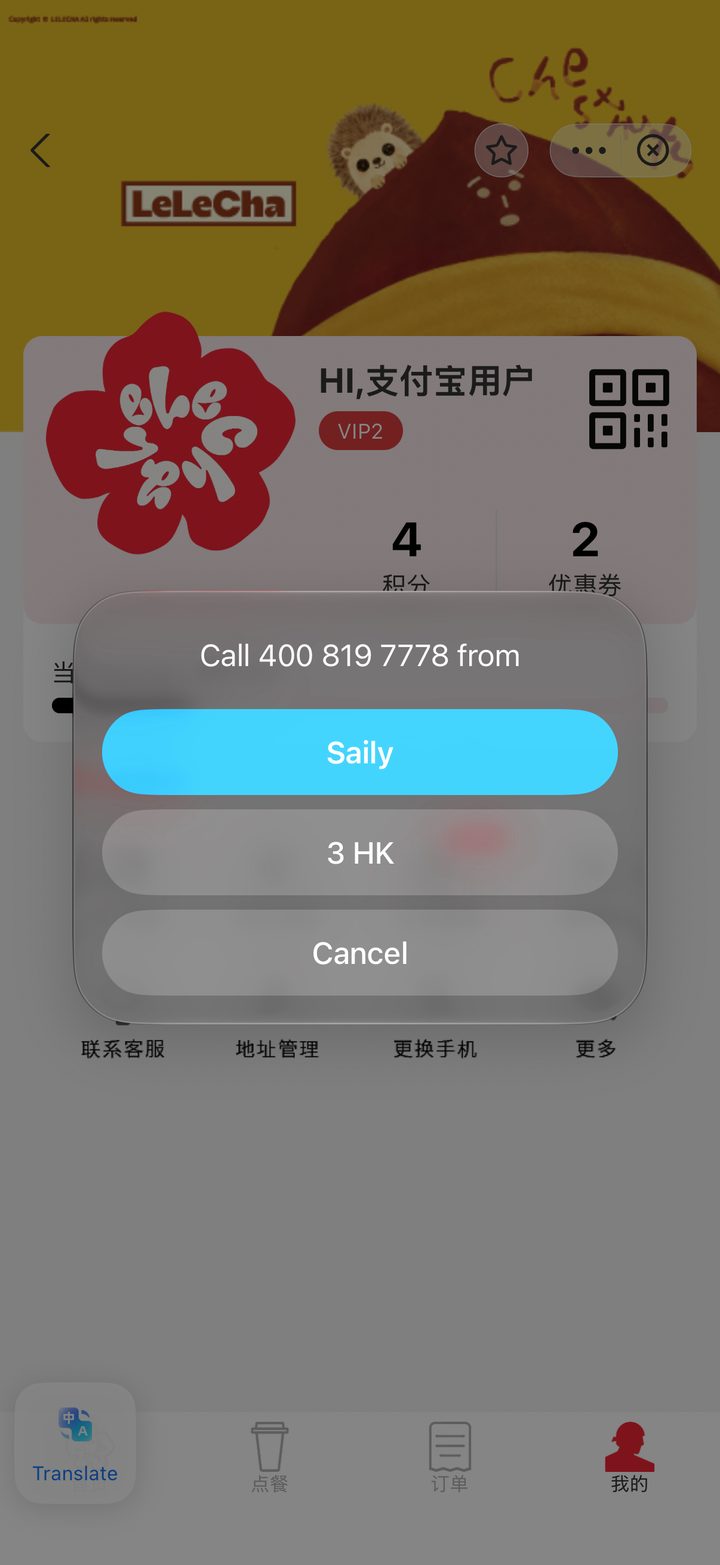
There is no chat
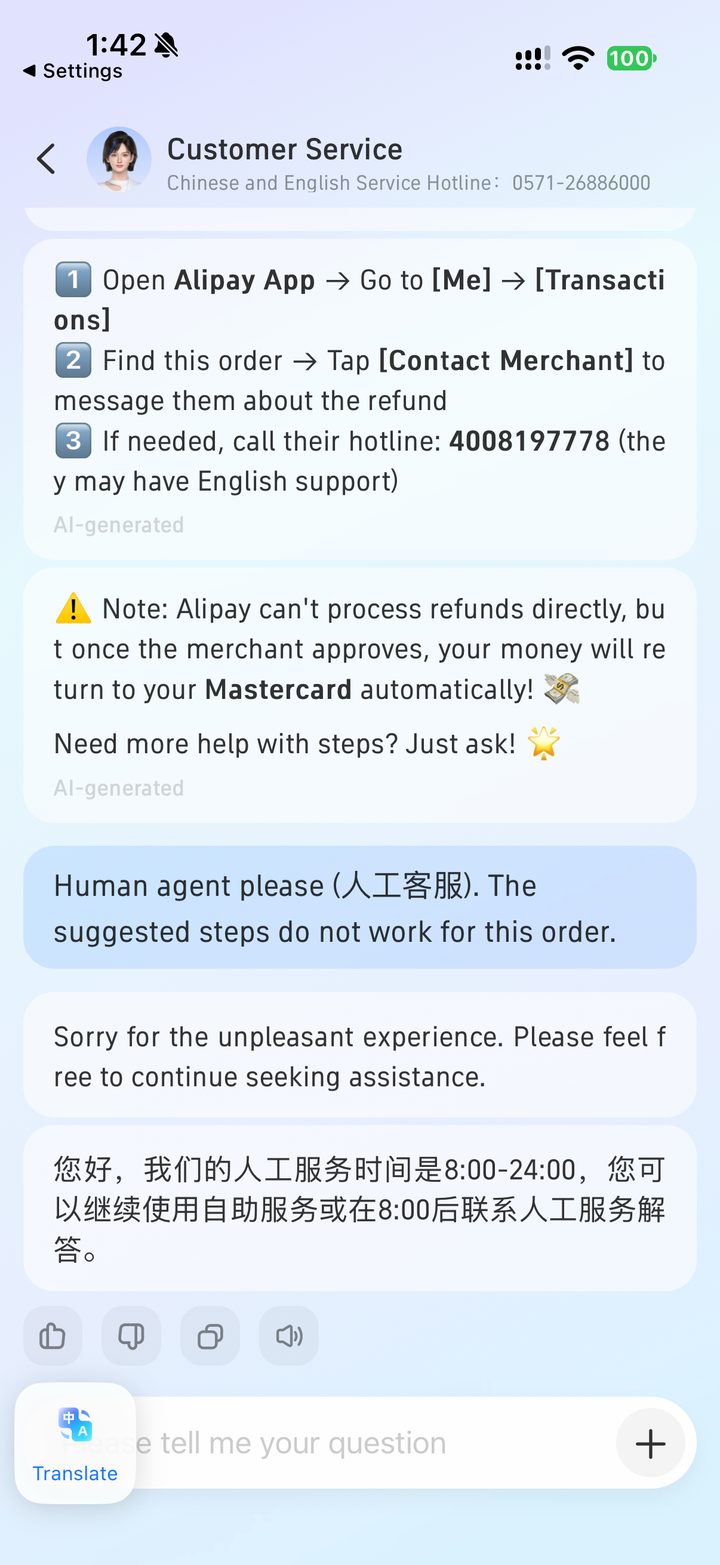
Humans: 8:00 to 24:00
Finally I asked for a human. The bot was sorry. Human agents work from 8:00 to 24:00. Please come back in the morning.
And of course, by then it was 2 a.m. and we were hungry again. Not jiaozi hungry. Proper-meal hungry. I opened Meituan, took the first screenshot, switched to Google Translate and felt my soul quietly leave my body. Twenty minutes later I had a half-translated menu, a cart I didn't trust and a mood I'd rather not describe.
But we had a secret weapon. Takeout! Our hero. The one mini program in all of Alipay that spoke English and brought dumplings. My partner had been knocking on its door since a quarter to eleven.
Takeout took one look and decided my partner was not human.
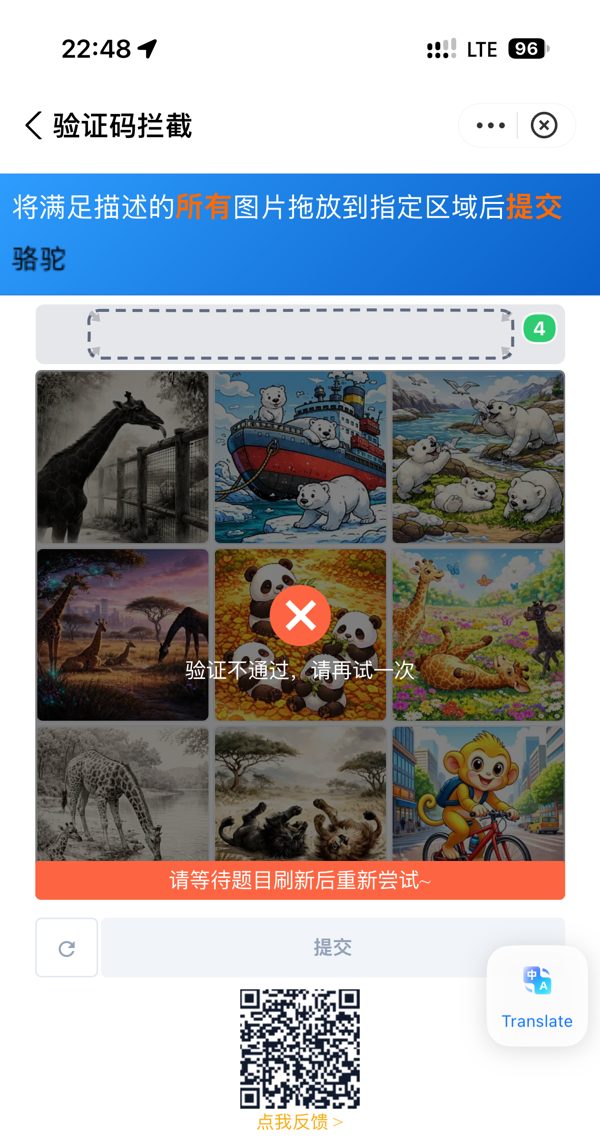
Up came a puzzle: nine pictures of animals and a line of Chinese. My partner tapped Alipay's Translate button, which thought about it for a moment and did nothing. So my partner took a screenshot, opened Google Translate, read the instruction, went back to the puzzle and found a completely different puzzle waiting. New animals, new instruction. Apparently it gets bored if you leave. Back to Google Translate, back to the puzzle, new puzzle. After the third lap I was fairly sure it was doing it on purpose.
Eventually we cracked it. Drag every picture of the animal into the box. Tonight's animal: 骆驼. Camel.
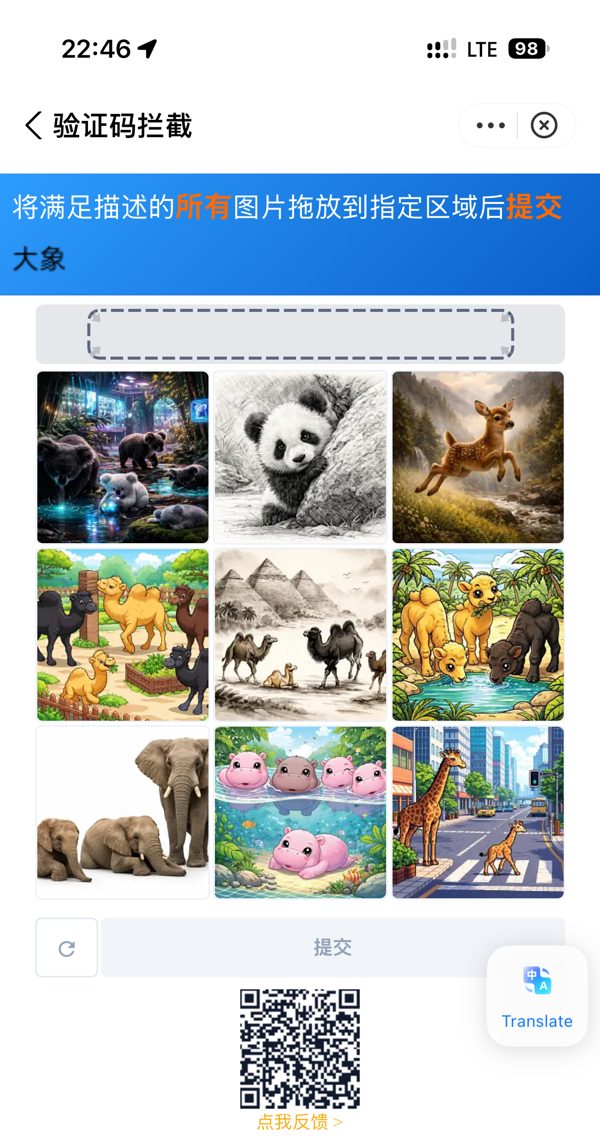
22:46 "Elephant"
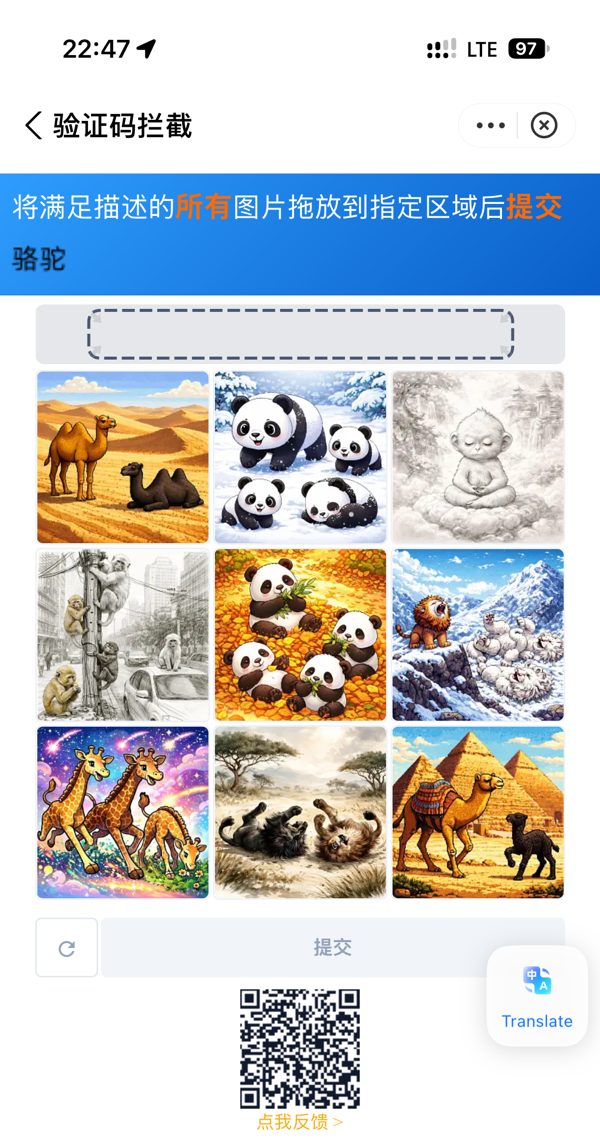
22:47 "Camel"
22:48 "Not human"
Easy. My partner is a human being with working eyes. But these were not normal camels. One posed in front of the pyramids in pixel art. Two lounged in a desert that looked like an old Windows screensaver. Meanwhile a monkey meditated on a cloud, a lion screamed at a mountain and three giraffes galloped through a rainbow galaxy. Whatever AI drew these had clearly been up even later than us.
Drag, drag, submit. Red cross. 验证不通过. Verification failed.
So we called in backup. I held my phone over my partner's with live translation running, like a nervous parent at a spelling bee. Camel. Camel. Definitely a camel. Submit. Red cross. Then a cheerful orange bar: please wait for a new question and try again~. The tilde was the worst part. It was smiling at us.
Think about that for a second. An AI drew the camels. A machine marked the answers. And two actual humans could not prove they were human. By round five my partner had stopped arguing with the app and started wondering if it had a point.
Twenty-four hours earlier, Takeout had been our best friend. Now it was a bouncer with folded arms, staring at my partner's shoes. "Not tonight." "Not tonight." "Still not tonight."
So there we were at 2 a.m.: one officially certified alien and one man with a half-translated cart, in a city of twenty-five million people who could all order dinner in under a minute. Hungry. Again.
Night three: Shanghai 2, me 1. And Shanghai was starting to look smug.
An AI drew the camels. A machine marked the answers. Two actual humans failed.
The DocQ reflex
"Fine. I'll do it myself."
Every Avengers fan knows the scene. Thanos has watched his minions fail him one too many times. He sighs, slides on the gauntlet and says: "Fine. I'll do it myself."
At 2 a.m., out ¥54, with one officially certified alien sitting next to me, I had my Thanos moment. With one small difference. I had already tried doing it myself. Three nights running. Doing it myself was exactly how we got here.
So I reached for a different gauntlet. Mine was a USB-C cable.
Building DocQ has changed how I look at problems. My day job is pointing AI at problems that are hard, boring, or both. Contracts nobody wants to read down to the last clause. Insurance claims buried in scanned forms and photos. HR paperwork that bounces between five inboxes and three approvals. At DocQ we build the agents that read it, check it, sort it and move it along, so people only touch the parts that actually need a person. So I know what an AI agent can do with something repetitive, annoying and full of text nobody wants to read. And when something is making life harder than it needs to be, I start wondering whether one could fix it.
That night it was dinner.
And frankly, it was war. Three nights, three ambushes. We had been 403'd, ghosted by a bubble tea and told by a camel puzzle that we weren't human. Fine. If the apps had decided we weren't human, we would stop fighting like humans. No more screenshots. No more squinting. No more politely dragging pixel-art camels into a box. I was sending in something that never gets hungry, never gets hangry, reads Chinese all night without complaining, and has never once been asked to identify a camel.
The idea was simple. Plug the iPhone into the laptop with a USB-C cable. Let an AI agent on the laptop see the phone's screen, read every button, translate it, and tap and type like a person would. I'd sit next to it and say what I wanted in English.
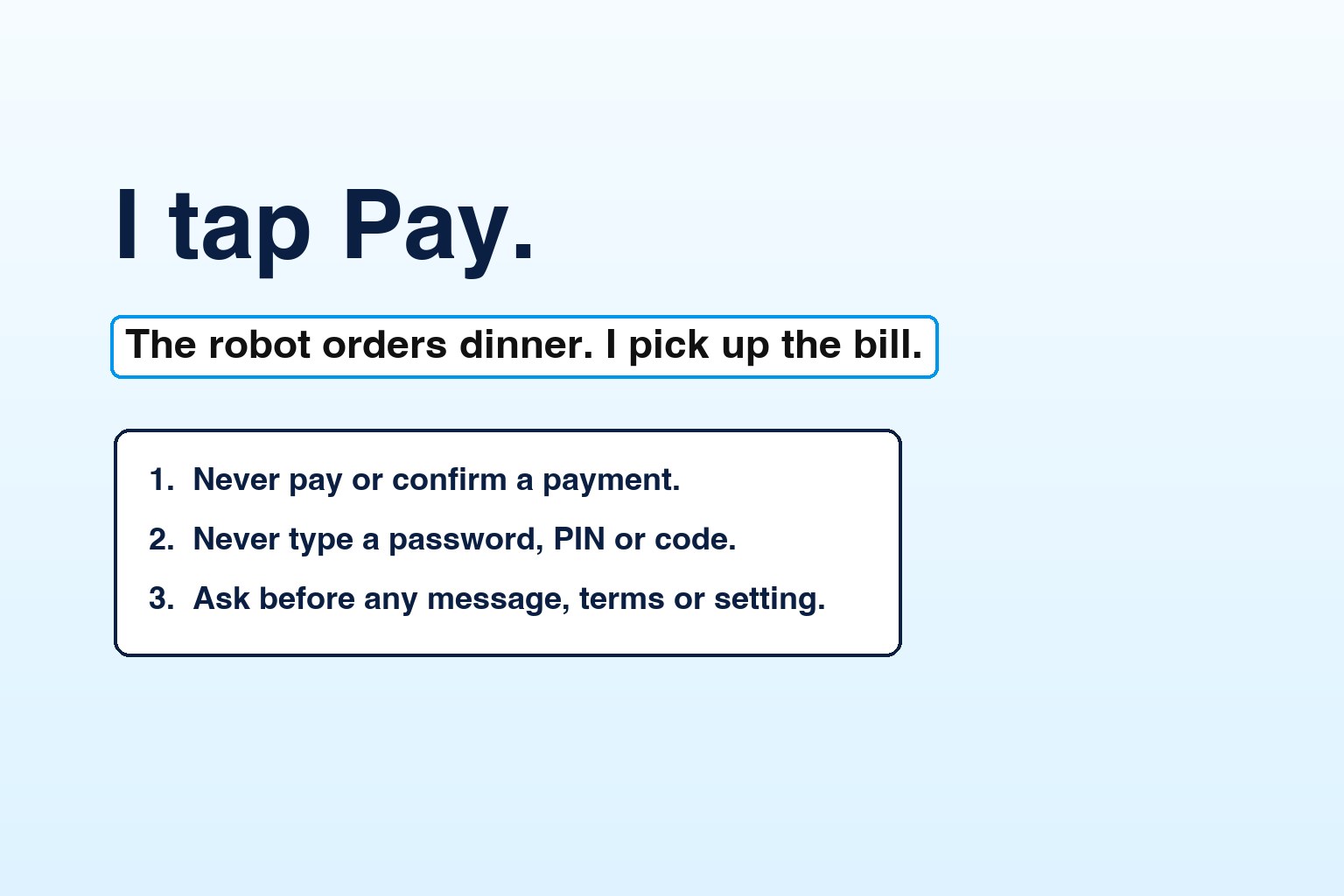
Handing your phone to an AI at 2 a.m. sounds like a bad idea. Thanos didn't set ground rules, and look how that went for half the universe. So before anything else, I gave mine some:
- Never place an order, pay, or confirm a payment.
- Never type a password, PIN or verification code.
- Ask me before sending any message, accepting any terms or changing any setting.
Stop at checkout and show me the summary. I tap Pay myself.
Those rules held all night. More on that later.
Setup
Everything says no
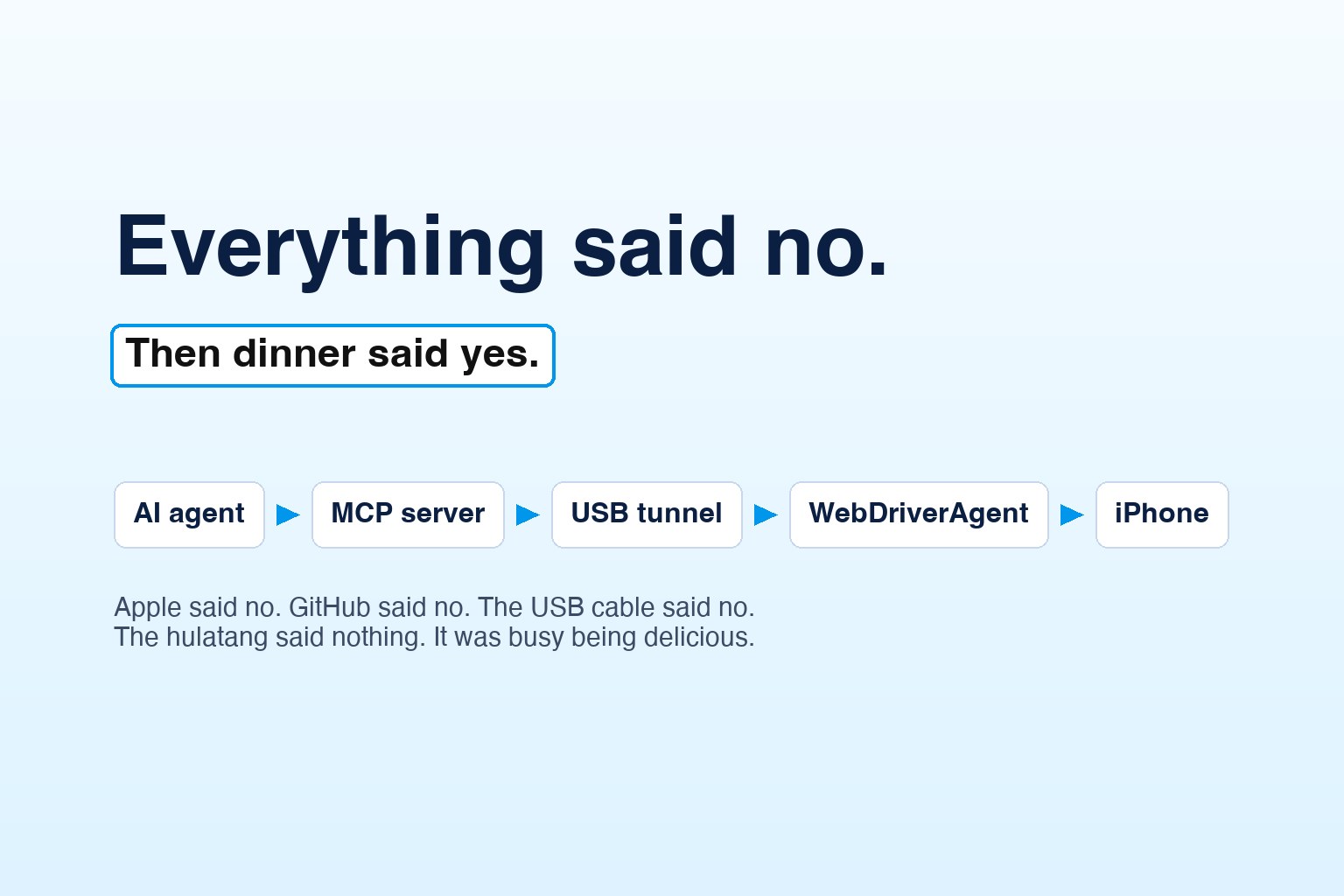
Getting an AI agent to drive an iPhone isn't a supported feature. It's a stack of developer tools glued together, and every layer of it had an opinion.
The shopping list had three things on it:
- Eyes. Something on the phone that lets a computer see the screen and press buttons. That's WebDriverAgent, a free test runner that app developers use to automate iPhone testing. It sits on the phone and answers questions like "what's on screen?" and "tap here, please".
- A cable. Something to carry those questions over USB. That's go-ios, a small open-source tool.
- Hands. A way for the AI agent to use all of it: an MCP server (mobile-mcp in my case), which turns "take a screenshot" or "tap the button that says 提交" into tools the agent can call.
How hard could it be?
Apple said no first. To run the little automation app on the phone you have to sign it with an Apple developer account. A free account works, but it quietly limits how many devices you've ever registered, and mine had hit the limit years ago. There's no reset button. The fix was a second Apple ID, and luckily I had one lying around, a souvenir from moving across continents. Apple accounts are tied to a country, and I've changed countries more often than Apple likes. For once, that paid off.
GitHub said no next. WebDriverAgent lives on GitHub, and downloading it timed out, again and again. That's normal from a hotel in Shanghai. The same code is published on npm, and China has fast npm mirrors, so I fetched it from there instead. Mental note: in China, mirrors beat GitHub.
Then the USB cable said no. This one was my favourite. Everything was built and signed, the agent connected to the phone, and the phone simply disappeared. Not crashed. Gone. As far as the laptop was concerned, I had pulled the cable out. I hadn't. I unplugged it, plugged it back in, and the phone came back.
The agent tried again. Gone again.
The first time, it looked like a loose cable in a hotel room. The second time, the agent lined up the logs and saw that the phone vanished in the same second as one specific thing: the tool it uses to talk to phones starting a little helper program in the background. That helper was new. The tool had recently switched to it as the default, and whatever it did when it woke up, it knocked my iPhone clean off the Mac's USB service, taking everything else connected to the phone down with it.
The fix was small and slightly cheeky. First, the agent told the tool to go back to its older way of driving the phone, through the test runner we had just built. But even in that mode, the tool still called the helper once at startup, just to check its version and ask whether any simulators were around. So the agent wrote an eight-line stand-in with the same name. Asked for its version, it gives the right answer. Asked anything else, it says "no devices". The tool is happy, the real helper never starts, and the phone stayed put from then on.
I've lost evenings to bugs like that. The agent found it in two replugs, and its fix was to politely lie to its own tooling.
About an hour after my Thanos moment, we got our hello world.
The agent started small. It asked the phone one question: are you there? WebDriverAgent answered with a little block of JSON that boiled down to "ready": true. Then it took a screenshot, and my home screen appeared on the laptop. So far, so polite. Then the real test. It found the Settings icon by its label, tapped it, and on the desk next to me, my phone opened Settings. Nobody had touched it. It went back to the home screen and swiped between pages, slowly, like someone trying out a new phone in a shop.
It felt a bit like watching a ghost use my phone. A ghost that, crucially, could read Chinese.
It reads
The phone, in English, live
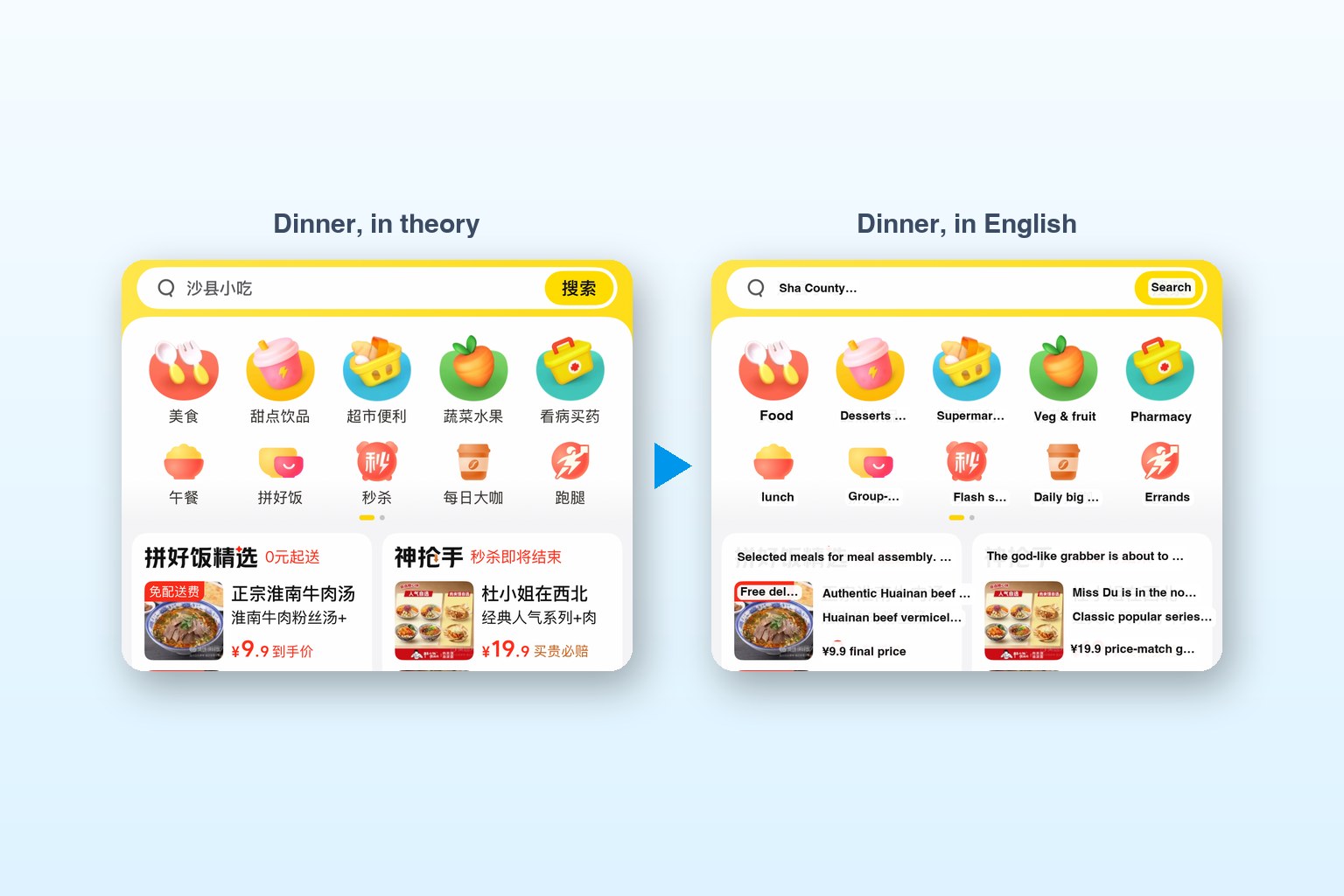
Now the fun part. I asked for a live view of the phone on my laptop, and then for a live translation: the phone on the left, and on the right the same screen with English painted over the Chinese, updating as I scrolled.
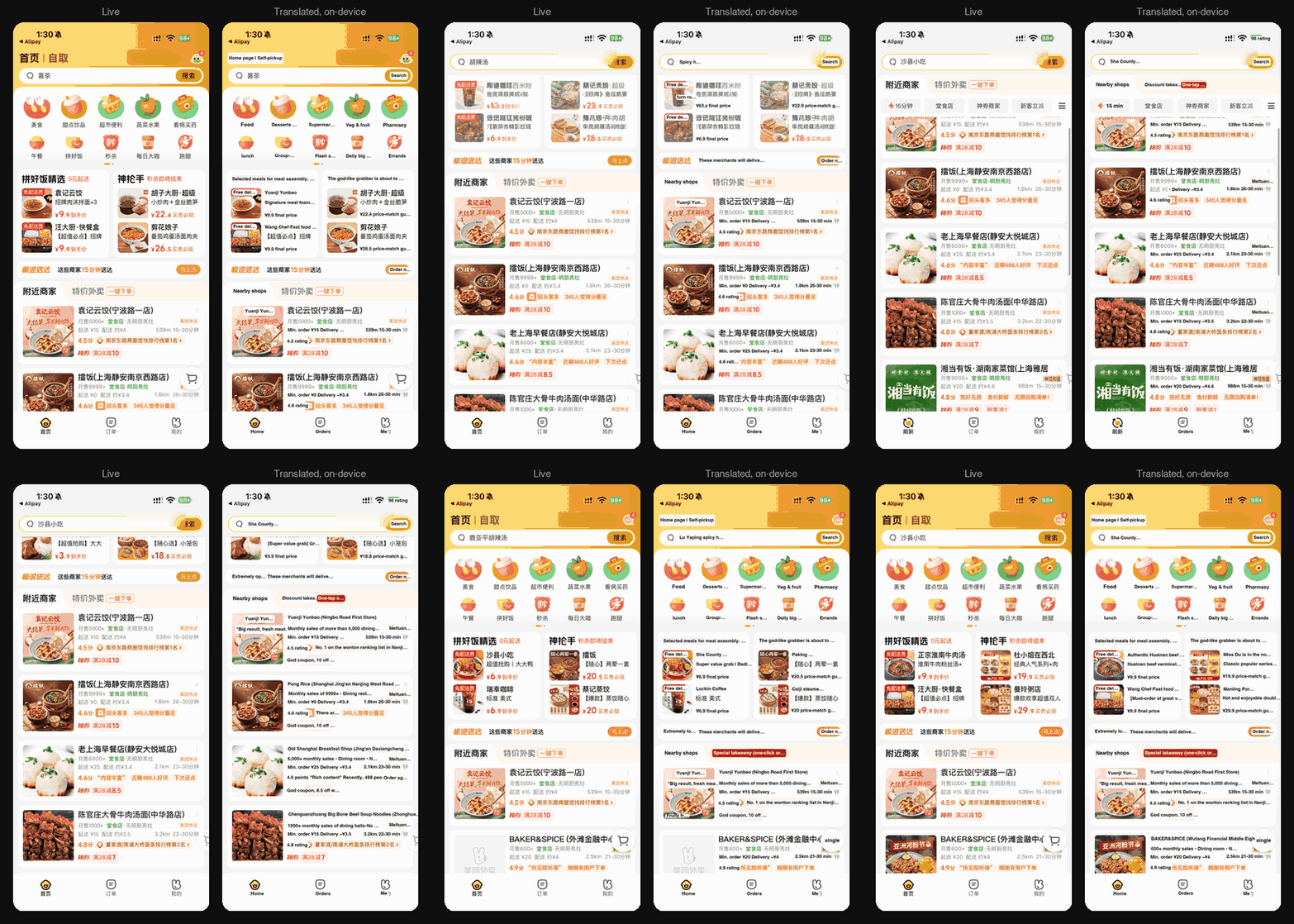
The first version worked and was useless. It translated everything before showing anything, so each new screen took ten seconds. The second version showed the screen at once and filled in the English in the background. Under a second per frame. Suddenly Meituan was a menu I could read.
The translation itself needed help too. A general translator is great at sentences and terrible at menus. Some favourites from that night:
拼好饭
"Cook the meal."
really: group-deal meals
买贵必赔
"If you buy it at a high price, you will be compensated."
really: price-match guarantee
a noodle shop's name
"Uncle Rice"
really: a perfectly normal name
起送 ¥25
"Free delivery from Yuanqi"
really: minimum order ¥25
惠
"favour"
really: deal
So the agent wrote a small glossary and a few rules for menu words: minimum orders, delivery fees, ratings, "sold out", "spicy level". After that, "起送 ¥25" came out as "Min. order ¥25", which is all you need at 2 a.m.
Detective work
It knows me better than I do
Before choosing food, I asked the agent a nosy question: what do I actually like?
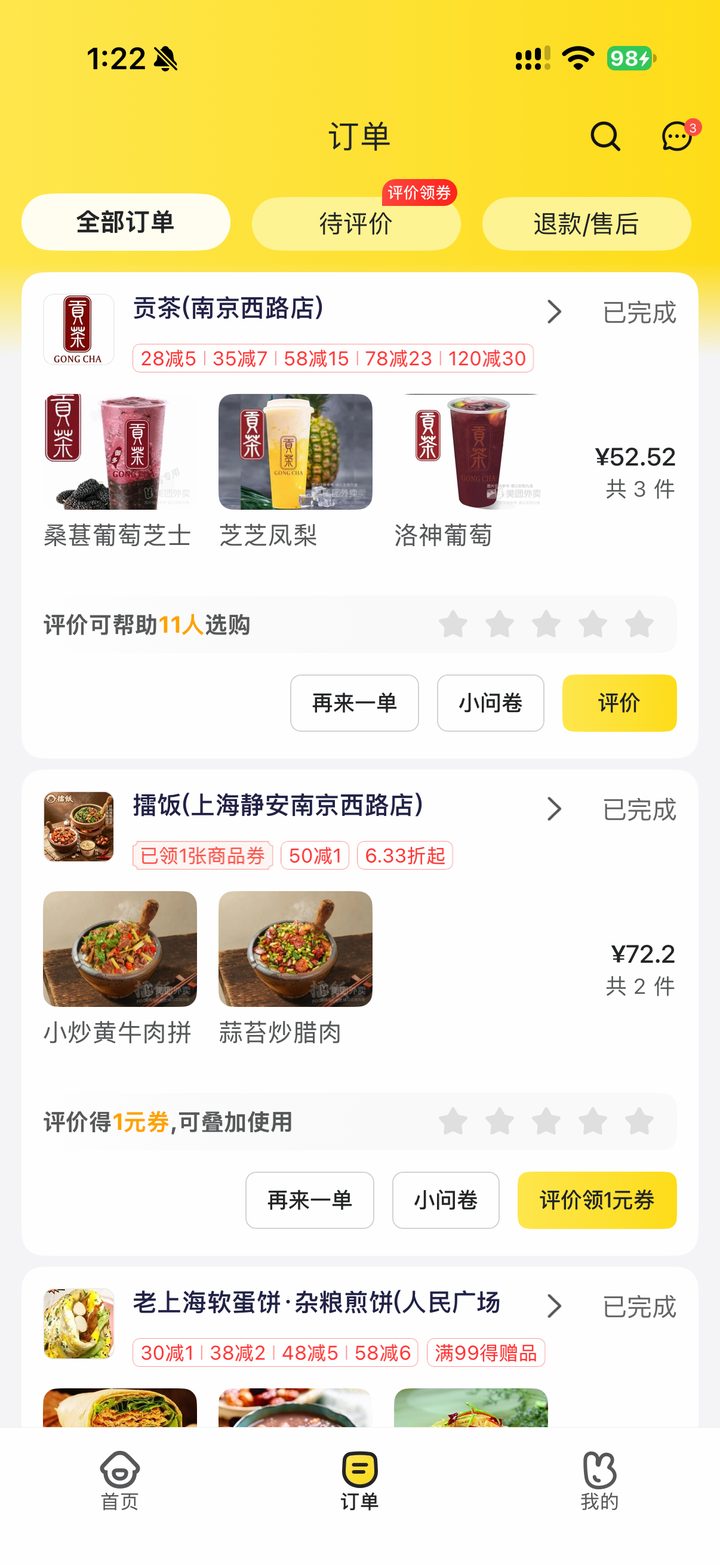
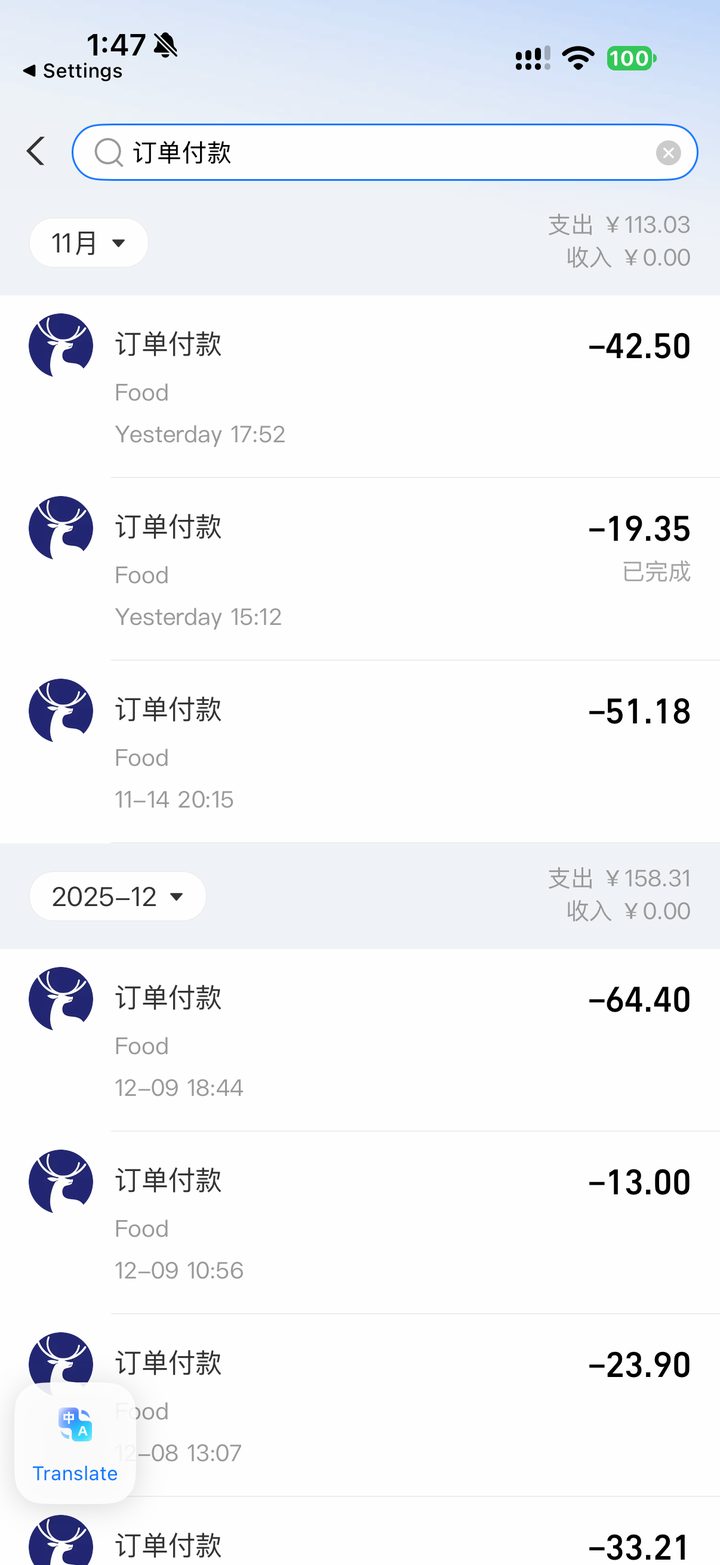
Then I watched it go through my life. It opened Meituan and scrolled my orders. It opened Alipay and read my bills. It went into the tea shops' own mini programs and pulled out every bubble tea I'd had in China. That took some digging. Luckin, for example, doesn't show up in Alipay as Luckin. It shows up as "order payment" with a little deer logo, so searching for the name finds nothing. The agent spotted the deer.
I'll be honest. Watching software rummage through my order history, on my own phone, is a little scary. Somewhere a privacy lawyer just sat up in bed. It's also a bit magic. And it's definitely science fiction. Not long ago this was a movie plot, usually the part just before the robots take over.
But put yourself in my slippers. A country where I can't read a single sign, where the translations sound like fortune cookies written by a confused poet, and where the apps think I might be a camel. In that world, this didn't feel scary. It felt like Star Trek.
Every Star Trek captain has two superpowers nobody ever explains. They say "Computer," and something answers. And thanks to the universal translator, every alien on every planet speaks perfect English. I had both, on a laptop, in a hotel room in Shanghai. Captain's log, stardate 2 a.m.: the crew is hungry, the locals are lovely, and the computer has located the dumplings.
Meituan history
Luckin, hiding as a deer
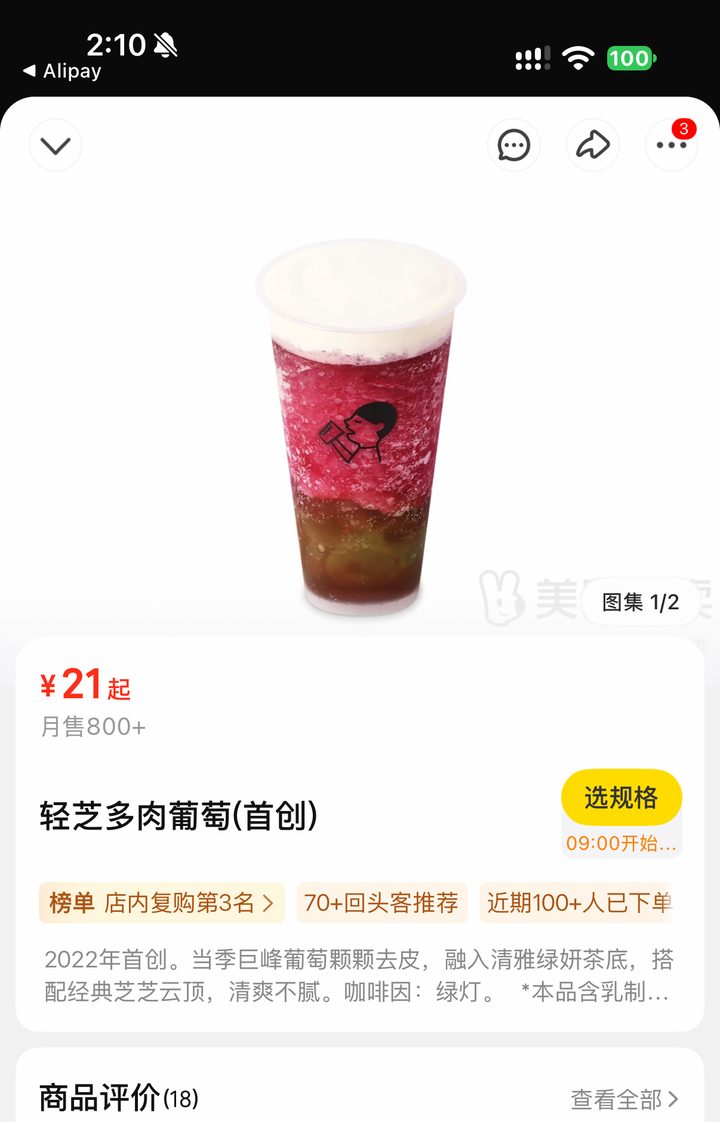
Its verdict: grape in almost everything, large, iced for fruit teas, less sugar, and a clear weakness for cheese foam. I'd have called that slander, except it was right. The cheese teas at Gong Cha were the best drinks of the trip. My partner is loyal to a roselle grape tea. And my favourite coffee in China turned out to be Luckin's hot molten cheese latte.
"What even is cheese foam?" I asked. A whipped cap of cream cheese, cream, milk and a pinch of salt, it explained, and then went and found the drink that made it famous so I could see it.
My rules, its job
No xiaolongbao. No crab. No seaweed.
Back to the real problem: food. I wanted something more substantial than last night's plain jiaozi. Here's the exact prompt, typos and all:
Me, to the agent
I don't want to eat xialongbao, but what best dumpling can you find me that will be delivered within 20-35 mins or so? Ask me questions after research, if you want.
I can't even spell xiaolongbao, and I was asking a machine to read Chinese for me. It didn't comment. Professional.
Halfway through its search I added "nothing with crab or crab roe". It said "Noted" and wrote it into its memory, so the rule would still be there the next night, and the one after. A minute later: "and no seaweed".
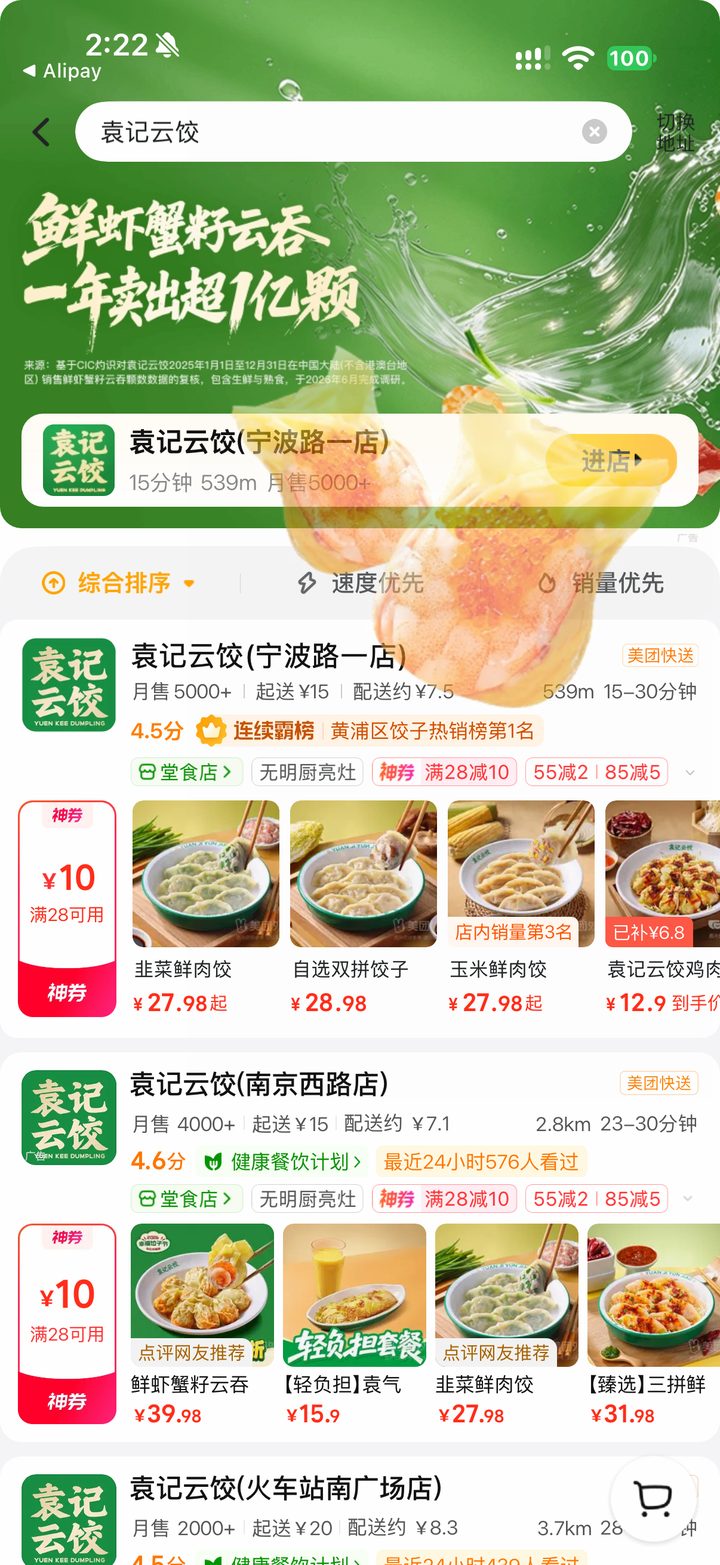
That's harder than it sounds when you can't read. Shanghai loves crab roe, and the most famous item at the closest dumpling shop was exactly that, on a giant banner. Plenty of soups quietly include seaweed by default. You only find out inside the option sheet.
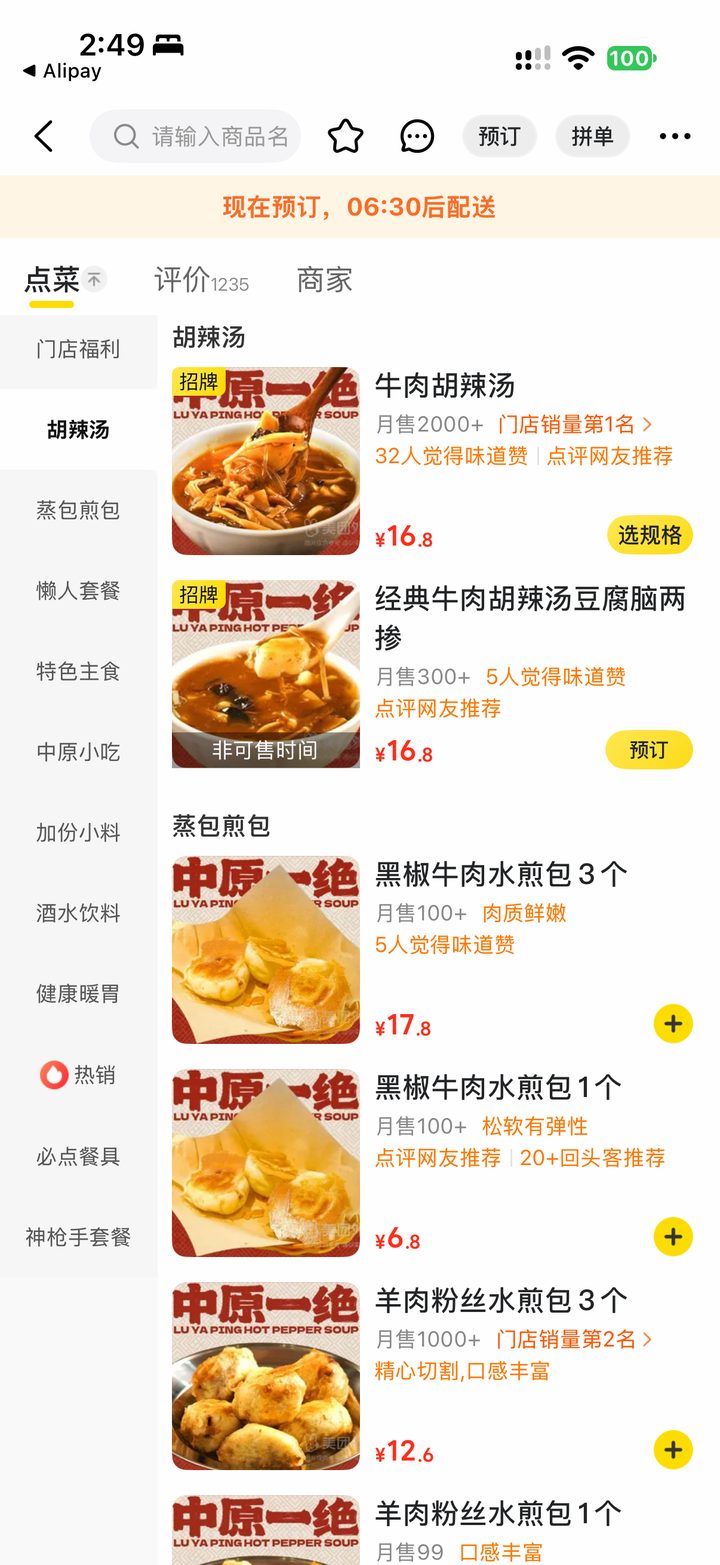
The shortlist came back as a neat table. The top-rated shop, a beef bone soup place at 4.9, looked perfect until the agent opened the sets: every dumpling came with a side of kelp. Out. The closest shop, 539 metres away, had a giant crab roe wonton banner floating over its menu. The agent flagged it as an ad, not a dish, kept the shop, and built me an English menu of its dumplings, with photos.
The famous one is crab roe
The one I wanted
Then I remembered something better than dumplings. Hulatang: a thick, peppery Henan beef soup you dunk fried dough into. We've been eating it since our very first trip to China, and we've loved it ever since. Now came the real test. Not dumplings off a list. A soup from another province, at 2 a.m., found by a contraption I'd stitched together that night out of a laptop, a cable and a borrowed test tool. Dr Frankenstein, if Frankenstein had shopped at an Apple Store. Would the monster walk?
In my head, I was on the bridge of the Enterprise: "Computer. Locate hulatang." In reality, I typed three words:
Me, to the agent
Hulatang with yotiau?
First xiaolongbao, now youtiao. I can't spell a single Chinese food. It didn't care.
Before searching, it pushed back. Classic Henan hulatang comes with shredded kelp. Kelp is seaweed. I had made that rule fifteen minutes earlier, about dumplings. It applied it to a soup I hadn't even ordered yet.
The monster walked. Lu Yaping, half a kilometre away, number three in Shanghai, with fried-to-order mini youtiao for dipping.
And it wasn't a random pick. The agent went through my Alipay history and found a ¥85 payment from December, at Lu Yaping on Hankou Road. We had eaten there and forgotten the name. Alipay hadn't.
The good part
A menu I could actually use
Reading a translated screenshot is fine. Reading a menu is better. The dumpling list had been a warm-up, so for Lu Yaping I asked for the real thing, and the agent built one: a real-looking English menu, every dish with its own photo cut from the app, a plain description, the price, the Chinese name for reference, and a plus and minus button. It put it online so I could open it on my phone in bed.
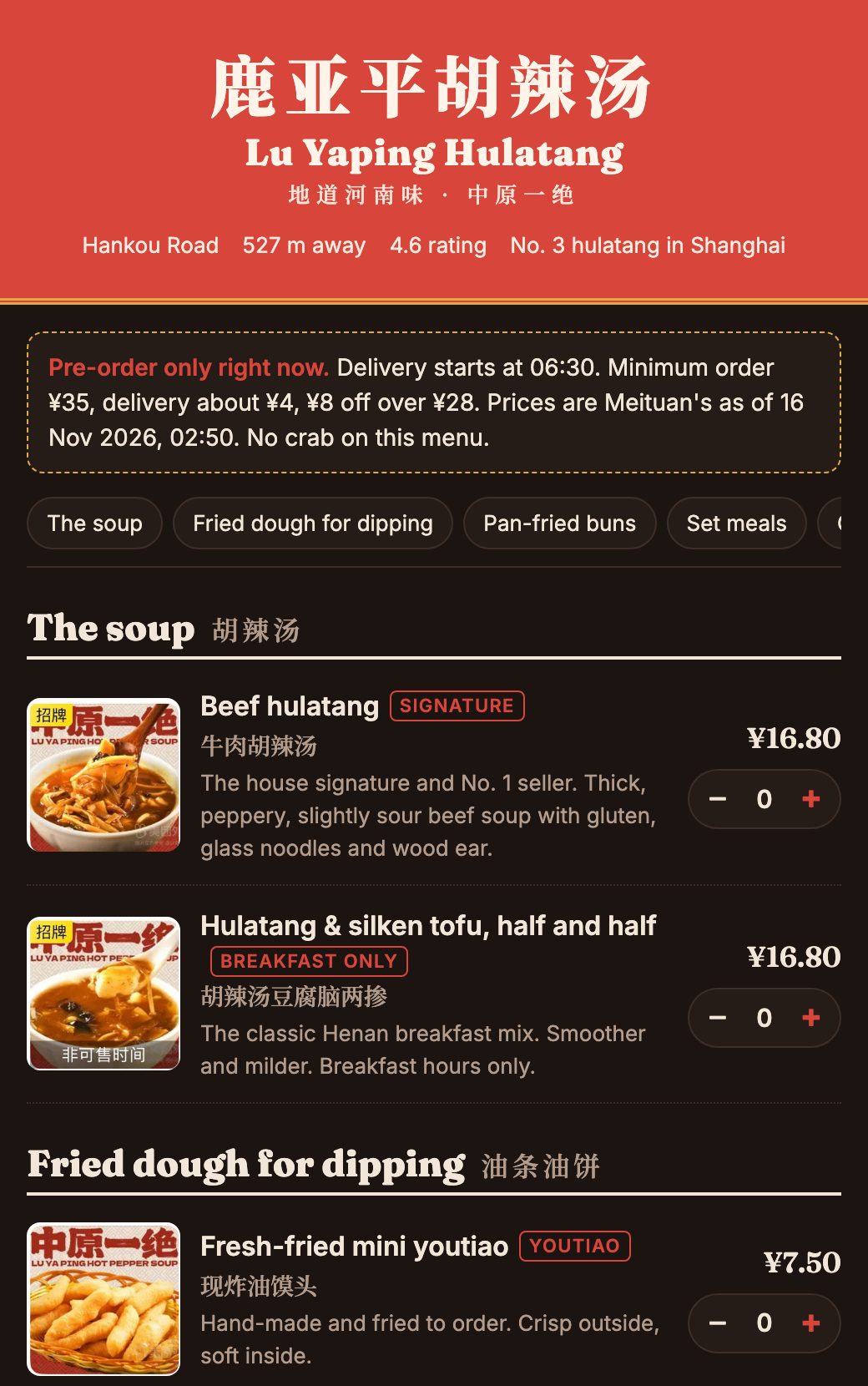
I picked. Beef hulatang, of course, two of them. Two portions of mini youtiao. Three little pots of chilli oil, because a Henan soup deserves backup. A plate of pan-fried black pepper beef buns because the menu said "crispy bottoms" and I am only human.
I hit Save. The agent read my picks straight off the page. No copying, no screenshots, no "can you type that in Chinese for me". My menu was now its shopping list.
Delivered
The agent fills the cart. I tap Pay.
Then the robot thumb went shopping, and it was not elegant.
First it tapped Meituan's search box and typed "hulatang". Meituan's search box has a rotating suggestion in it, and the thumb typed into the suggestion instead. Result: HeyTea. A bubble tea shop. Even the robot can't escape bubble tea in this city.
Then the shop's own search crashed with my favourite error message of the entire trip: 信号可能跑到外星球了哦~ "The signal may have run off to another planet~". Next to it, a yellow kangaroo stared at the moon through a telescope, looking for it. Hours earlier, a CAPTCHA had decided my partner wasn't human. Now the app was suggesting the internet had emigrated. Honestly, fair.
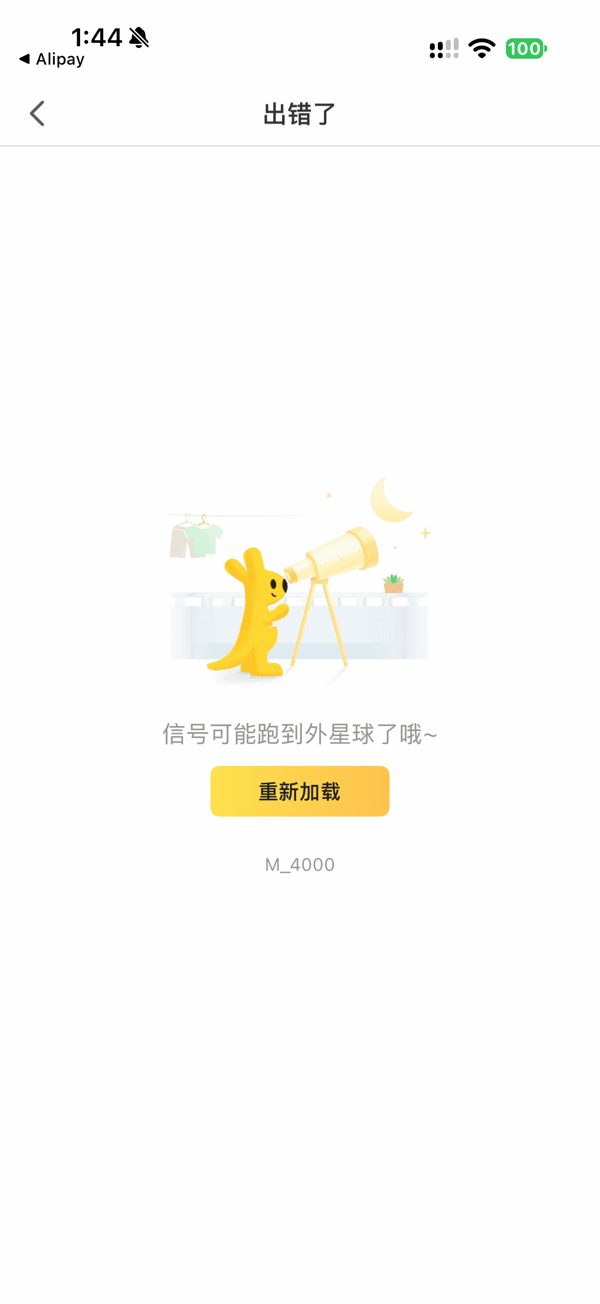
It went back, scrolled the menu like a person would, and added everything. Then it read its own cart back and found two mistakes: a sweet sticky rice cake I had never asked for, and one youtiao missing. Out with the cake, in with the youtiao. The robot thumb makes typos too. The difference is that it checks.
It also found an ¥18 red packet sitting unused in my account and applied it. ¥22 off in total. That coupon had been there for days. I had no idea. Detective work pays, literally.
Then it stopped, exactly as promised. On my laptop it showed the summary in English: two hulatang, two youtiao, the buns, three chilli oils, and two sets of cutlery, because this shop charges 50 fen for chopsticks and lists them like a dish. ¥55.90, delivery free. And one question: classic hulatang comes with kelp, so should it add a "no kelp" note?
I said no. This shop's hulatang is the reason we came. Rules are rules, but some soups are above the law.
I picked up the phone and tapped Pay myself. One tap. My snap. Nobody turned to dust, and dinner was on its way.
The app promised 15 to 30 minutes. Eleven minutes later, it said delivered. Eleven. I hadn't even found my slippers.
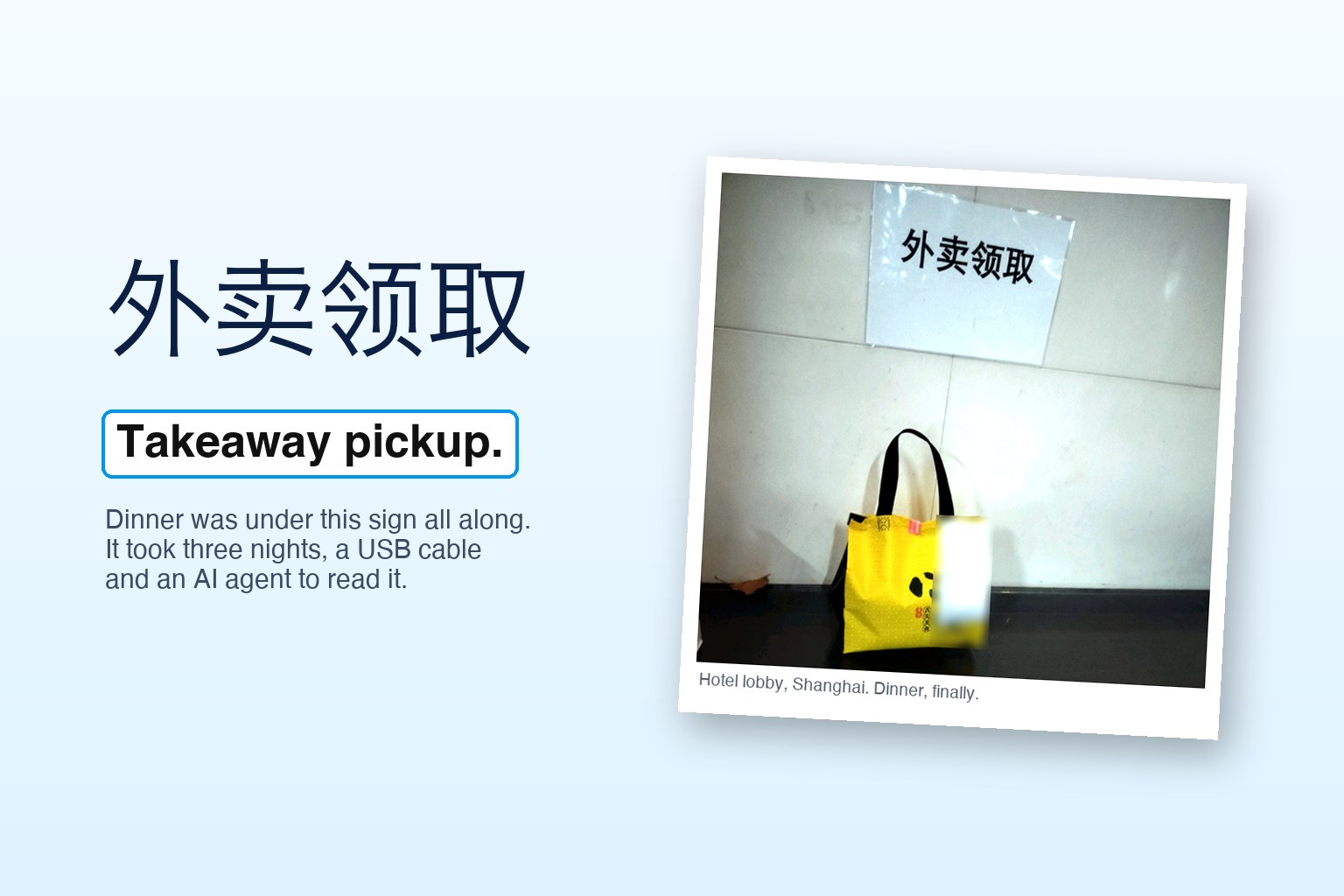
Then the rider sent a photo. Our yellow bag, on a dark table on the ground floor, under a sign. A printed sign, in a plastic sleeve, that said 外卖领取. "Takeaway pickup."
The night before, I had walked up to that exact sign at 1 a.m. and decided, on ten years of hotel loyalty and zero words of Chinese, that it meant delivery pickup. The agent translated it in under a second. I was right. I will be mentioning this at every dinner for the rest of my life.
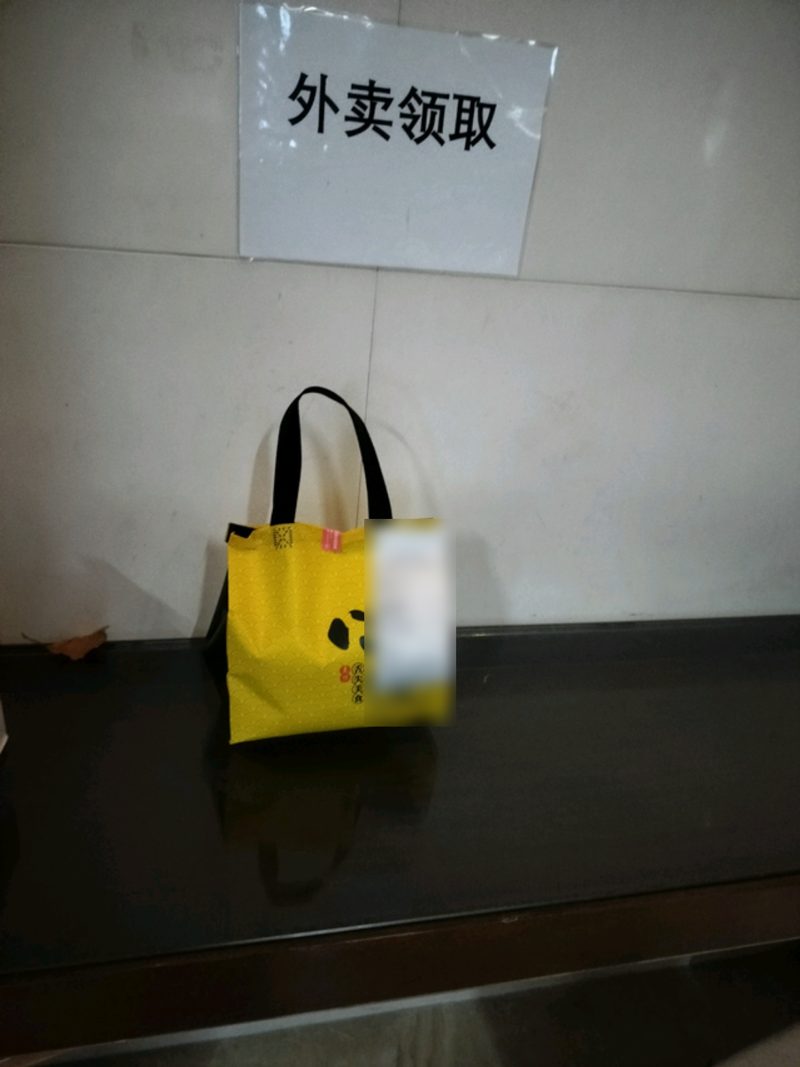
The sign. Confirmed.
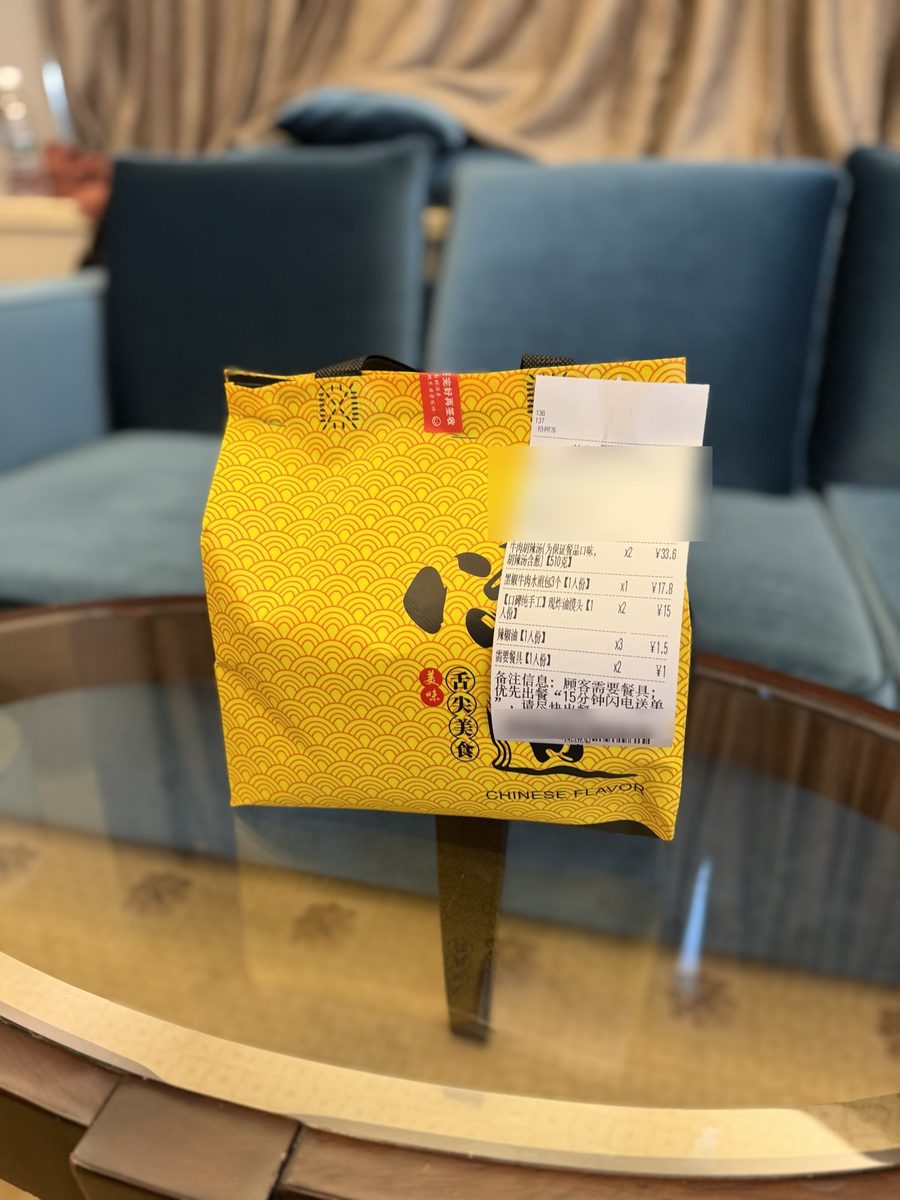
Dinner, actually delivered
Five minutes later I was sitting in the room with a steaming bowl of hulatang, dunking youtiao, laughing about "Cook the meal."
Dessert was the last test. Our usual cheese pineapple tea only came at 70% sugar. I wanted 30. There was no button for 30. So the agent wrote a note to the shop, in Chinese: 芝芝凤梨三分糖,谢谢. "Cheese pineapple, 30% sugar, thanks." The tea arrived noticeably less sweet. Perfect, actually. The app said no. The note said please. The note won.
Final score: Shanghai 2, me 3. Well, me and a robot.
What it says about how I work
Automation is a habit, not a project
None of this needed a lab or a big budget. It was a laptop, a cable, open-source tools and an AI agent with clear rules, put together in a hotel room after midnight. That's the part I like most.
Three things I'll take back to work:
Point models at the annoying part. The agent didn't replace Meituan or Alipay. It sat on top and dealt with the bit that was hard for me: reading Chinese, digging through history, checking options. That's how I approach client work at DocQ, whether it's a pile of contracts or a claims queue.
Rules first, then freedom. Once the agent knew it would never pay, never type a code and always ask before sending, I could let it do everything else. Clear guardrails are what make it safe to hand over the boring 95%.
Keep a human on the button that matters. The agent did the work. I tapped Pay. That split felt right at 2 a.m. in Shanghai, and it feels right for business processes too.
Epilogue
Lucy, and the tea in a parallel universe
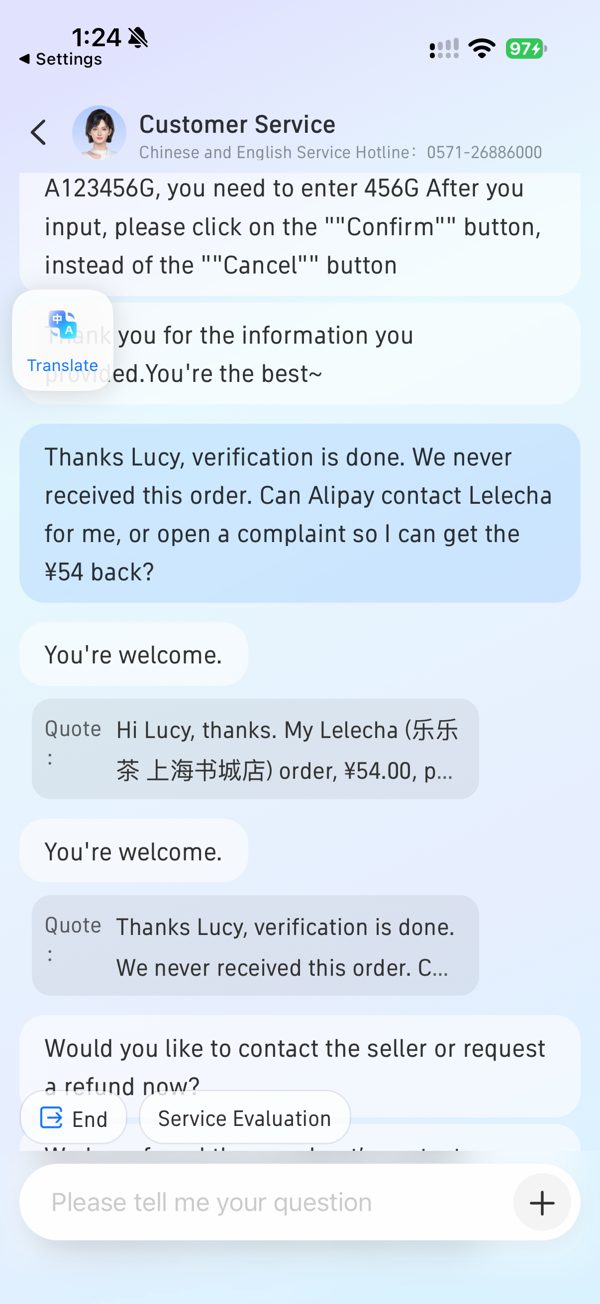
As for the ¥54 bubble tea: the next day, at a civilised hour, the agent reopened the support chat, asked for a human, and got one. Her name was Lucy. She spoke English, she was lovely, and the first thing she asked for was the last four characters of my passport. The agent took its hands off the phone and passed it to me, exactly as instructed. I typed them in. Lucy replied: "You're the best~"
Rewind a minute. Getting to Lucy took one sentence. The 2 a.m. chat was still there, now labelled "historical dialogue transcript", with the bot's "humans work 8:00 to 24:00" brush-off preserved like a museum exhibit. Right above it, in the header, sat a Chinese and English hotline we had somehow never noticed. At 2 a.m. you don't notice much.
The agent opened with the magic words, in both languages: "人工客服. Human agent please." The bot offered a representative by chat or by call. The agent picked chat. It never taps call. Honestly, neither do I, if I can help it.
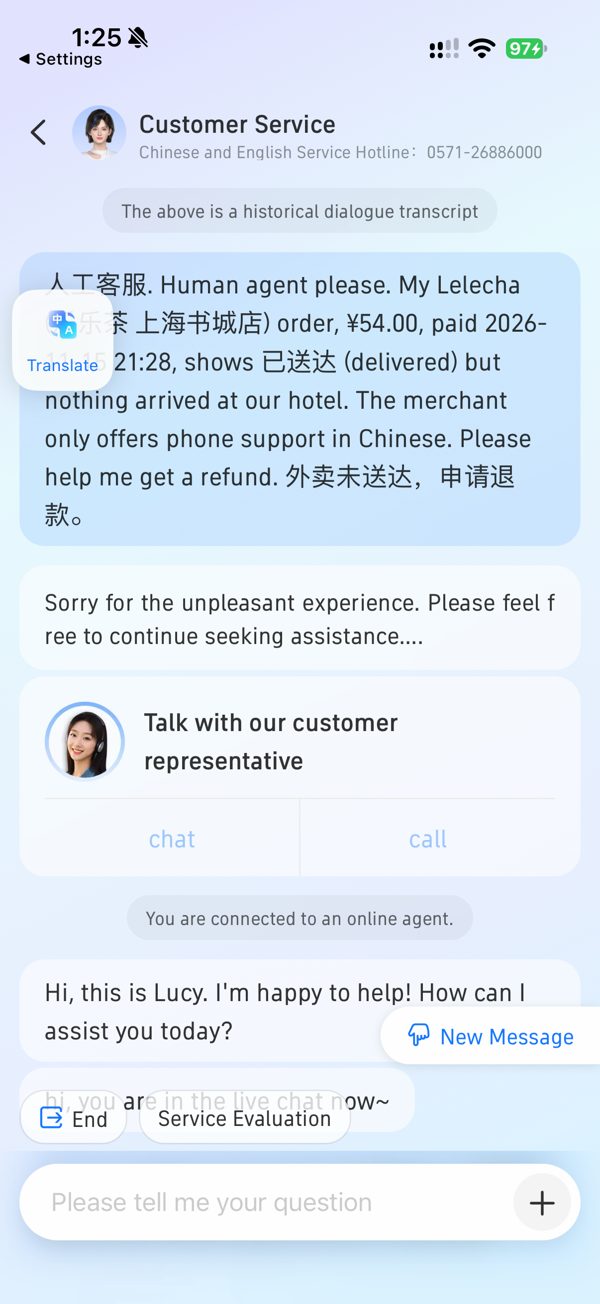
"Human agent please." Then: Lucy.
Passport digits: my job, not the robot's
Then the robot thumb hit a snag of its own. My messages kept arriving in Lucy's chat missing their last letter. "Refund" lost its question mark. With the keyboard up, the screen shifted, and the agent's tap on Send was landing on backspace. It noticed, worked out why, and started closing the keyboard before every Send. Lucy, to her credit, never asked why I typed like a man in a moving taxi.
Then the dance. Call the merchant? Chinese only. Use the "Apply for After-sales/Refund" button? There is no such button. The agent went and checked again anyway, keeping the chat alive on a three-minute timer. Still no button. Lucy was devastated: "Sorry and apology can not express my feelings for now, I deep apologize for this." Same, Lucy. Same.
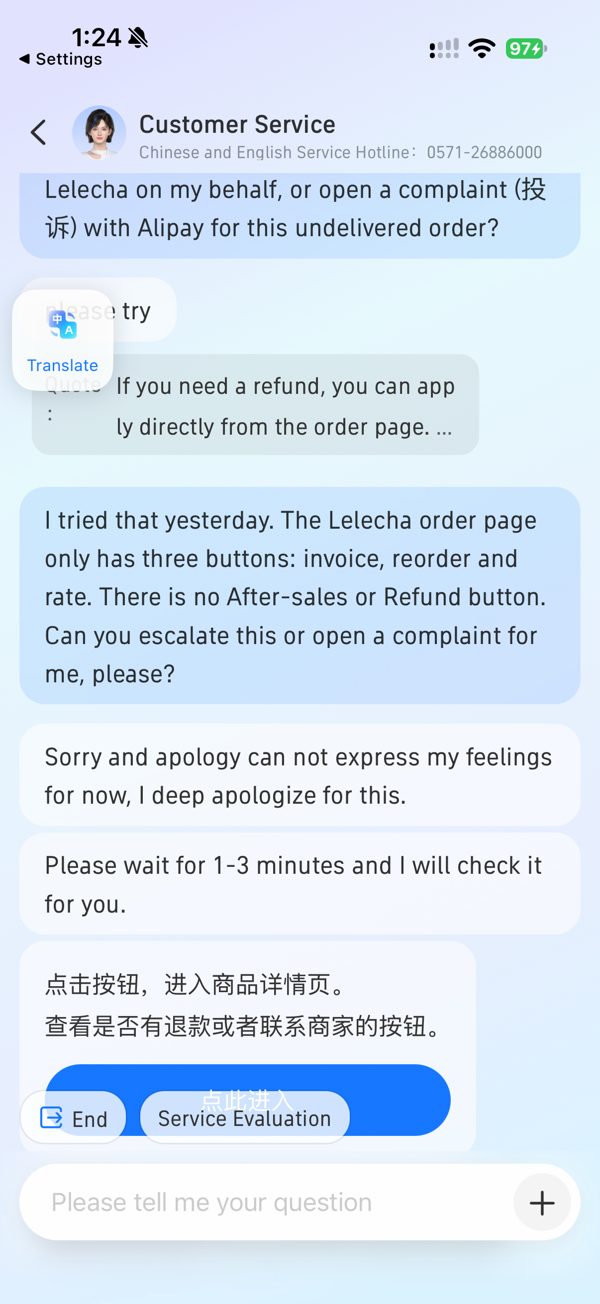
"Sorry and apology can not express my feelings"
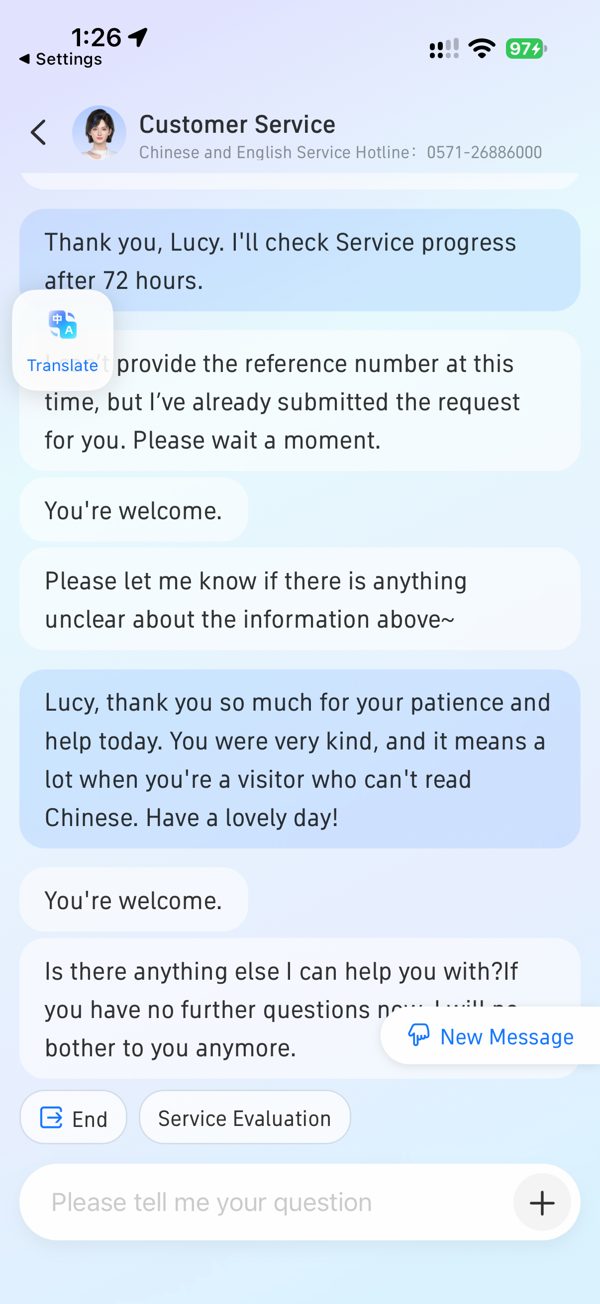
"I will no bother to you anymore."
Before she escalated, Lucy asked if she could share my order and contact details with the merchant. That's a real decision about my data, so the agent stopped and asked me. I said yes. Merchants "may contact you by phone or text message", she said. We asked for text, please, since a phone call in Chinese is where this whole saga started. "I'll make a note for you."
In the end she filed a complaint, and Lelecha now has 72 hours to sort it out. Will Alipay refund me if they don't? "The merchant's reply shall prevail." A case number? Not at this time. So the tea is still in its parallel universe, but now there's paperwork. Lucy signed off with the most polite goodbye I've ever had: "I will no bother to you anymore."
The 72 hours run out on Thursday. If Lelecha calls, it'll be in Chinese. If they text, the agent will read it to me. And if a rider ever does turn up with that tea, I know exactly which sign he'll leave it under.
Built with WebDriverAgent, go-ios, mobile-mcp, Apple Vision and the Apple Translation framework, all running locally. Screenshots are real and blurred where they showed personal details. Some timings are compressed for the story.
More detail: How an AI agent drives an iPhone · Live translation, on the laptop · Guardrails in practice
Anuj Sehgal · CEO, DocQ
He builds AI agents for documents and business processes, and occasionally for dinner. Say hello on LinkedIn.