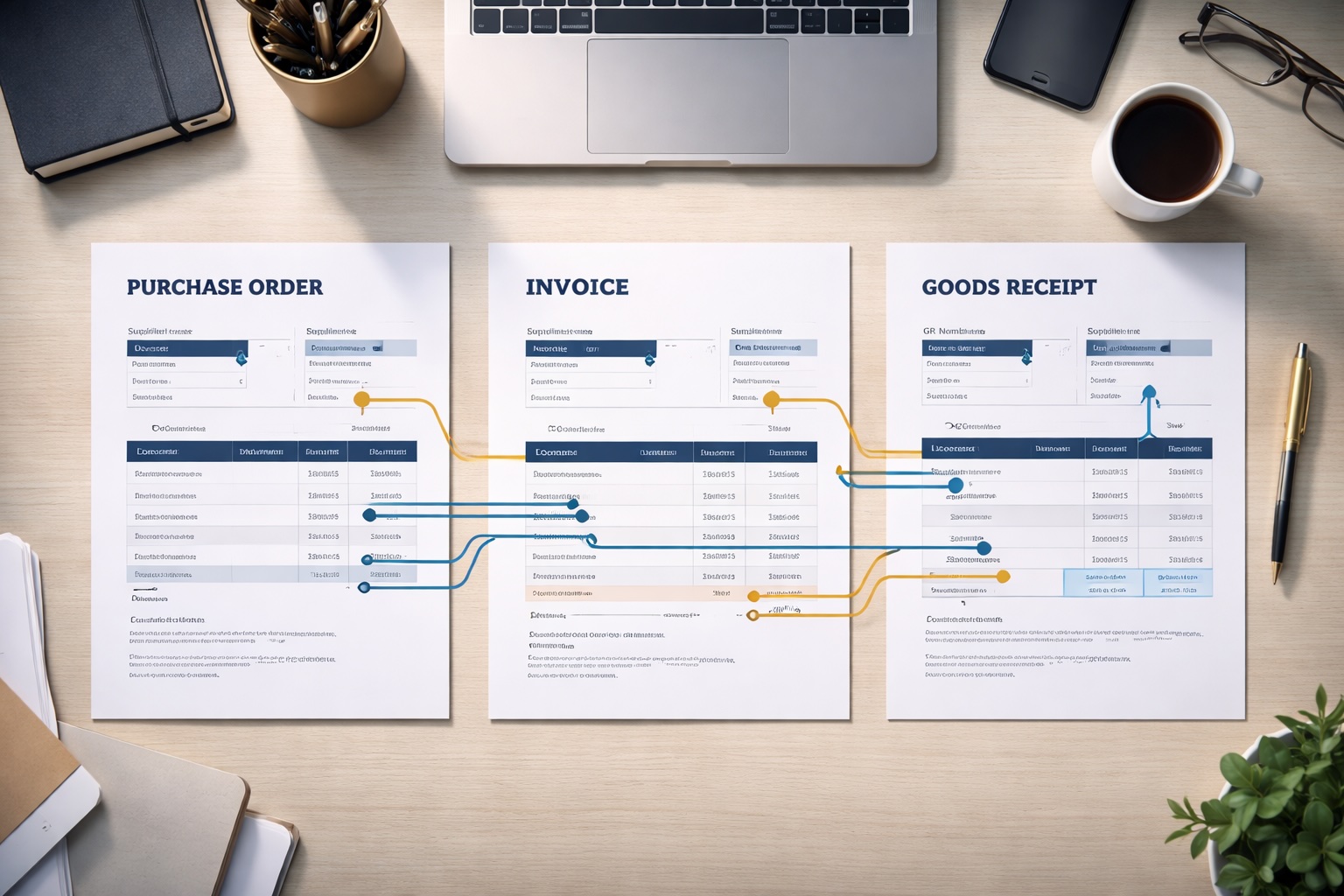
What PO Matching Actually Does
Purchase order matching is the control mechanism that ensures your organization pays only for what it ordered and received. Compare the invoice to the purchase order, verify the numbers line up, and approve for payment. Simple in principle. In practice, it's one of the most error-prone steps in the entire procure-to-pay cycle.
At low volumes, matching survives on spreadsheets and human judgment. At scale — thousands of invoices monthly, dozens of vendor formats, multiple ERP instances — it becomes either the backbone of financial controls or the bottleneck that buries your AP team in exceptions.
Two-Way Matching: PO vs Invoice
Two-way matching compares two documents: the purchase order and the supplier invoice. The system checks whether the invoice amounts, quantities, unit prices, and line item descriptions align with what was originally ordered.
This method works well for:
- Service-based purchases where there is no physical delivery to confirm (consulting fees, SaaS subscriptions, maintenance contracts)
- Recurring fixed-price agreements where the PO terms don't change month to month
- Low-value purchases where the cost of three-way verification exceeds the risk of overpayment
Two-way matching is faster and simpler to automate because it involves fewer data sources. If the invoice says $10,000 for 500 units at $20 each, and the PO says the same, it's a match. But it has a blind spot: it trusts that whatever was invoiced was actually delivered. For physical goods, that assumption can be expensive.
Three-Way Matching: PO vs Invoice vs Goods Receipt
Three-way matching adds a third document to the comparison: the goods receipt note (GRN), also called a delivery note or receiving report. Now the system verifies not just that the invoice matches the order, but that the goods were actually received in the quantity and condition specified.
The three-way check confirms:
- PO to Invoice — Did the supplier invoice match what was ordered?
- PO to GRN — Did the warehouse receive what was ordered?
- Invoice to GRN — Does the supplier's bill match what was actually delivered?
This is the standard for any purchase involving physical goods, capital equipment, or raw materials. It catches overbilling for undelivered items, invoices submitted before delivery is complete, and quantity discrepancies between what the supplier shipped and what the warehouse received. For manufacturing organizations handling raw materials across multiple plants, three-way matching is non-negotiable.
Where Matching Breaks Down at Scale
The logic of PO matching is simple. The execution at enterprise scale is not. Here are the failure modes that turn matching from a control mechanism into a full-time job:
Price variance. The PO says $14.50 per unit. The invoice says $14.75. Is this a billing error, an agreed-upon price adjustment, or a currency rounding issue? Multiply this ambiguity across thousands of line items and you have a mountain of exceptions that each need human investigation.
Quantity discrepancies. Partial deliveries are normal in manufacturing procurement. A PO for 10,000 units might be delivered in four shipments of 2,400, 2,600, 2,500, and 2,500. Each delivery generates its own GRN, and invoices may arrive per-shipment or consolidated. The matching logic needs to track cumulative receipt against the full PO.
Unit-of-measure mismatch. The PO specifies kilograms. The invoice lists metric tons. The GRN records pallets. The underlying quantities may be correct, but the matching engine sees a discrepancy because the units don't align. Without UOM conversion logic, every one of these becomes a false exception.
Tax rounding. GST, VAT, or sales tax calculated on line items individually often produces a different total than tax calculated on the invoice subtotal. A one-cent rounding difference on each of 50 line items produces a $0.50 total variance. It's immaterial, but a rigid matching system flags it as a mismatch.
Supplementary charges. Freight, insurance, handling fees, and packaging charges appear on invoices but not on the original PO. Three-way matching systems that can't account for known supplementary charge categories generate exceptions on every invoice that includes shipping costs.
At one global automotive manufacturer, which processes over 10,000 invoices monthly across 40+ manufacturing plants on multiple SAP instances, these failure modes weren't edge cases — they were the daily reality. Before automation, the AP team was spending 60-70% of its time on data entry and manual reconciliation, with invoice processing stretching to 10-15 days.
Most legacy ERP systems and first-generation AP tools respond to these failure modes with a binary pass/fail check — the invoice either matches the PO exactly, or it doesn't. This rigidity compounds every problem listed above. It generates an unmanageable volume of false exceptions, the queue grows faster than the AP team can clear it, and the control mechanism intended to prevent overpayment becomes the bottleneck that delays all payments. Worse, when 80% of flagged mismatches turn out to be immaterial — a $0.03 rounding difference, a 0.1% price variance — reviewers learn to rubber-stamp exceptions. The genuine billing errors get lost in the noise.
Configurable Tolerance Thresholds: The Missing Layer
The solution is tolerance-based matching — configurable rules that define what constitutes an acceptable variance versus a genuine exception.
A well-designed tolerance framework operates on multiple dimensions:
- Percentage tolerance — allow a 2% price variance on line items (covers minor price adjustments and rounding)
- Absolute tolerance — allow up to $5.00 total variance per invoice (covers tax rounding and trivial differences)
- Quantity tolerance — allow receipt of 98-102% of ordered quantity (covers standard shipping variance)
- Combined thresholds — a variance must exceed both percentage and absolute limits before triggering an exception
Tolerances should also be configurable by context:
| Dimension | Example Configuration |
|---|---|
| Vendor tier | Strategic suppliers: 3% tolerance; new vendors: exact match required |
| Invoice category | Raw materials: strict three-way match; office supplies: two-way with 5% tolerance |
| Amount threshold | Invoices under $500: auto-approve within 5%; over $50,000: exact match with director approval |
| Plant or entity | Different tolerance rules for different subsidiaries or jurisdictions |
When DocQ processes invoices for organizations at this scale, the matching engine applies these layered tolerances automatically. Invoices within tolerance proceed straight to approval. Invoices outside tolerance are routed to exception queues with specific discrepancy details — not just "mismatch detected," but "line 3 price variance of 4.2% exceeds 2% threshold, $0.75 over absolute limit." That specificity is what allows AP teams to resolve genuine exceptions in minutes instead of hours.
The result there was a reduction in processing time from 10-15 days down to 3-5 days, a 90% reduction in errors, and procurement approvals dropping from 5-7 days to under 24 hours.
Eliminating the OCR Bottleneck
Tolerance thresholds only work if the data feeding the matching engine is accurate. And data accuracy starts with extraction.
Traditional OCR solutions require template configuration for every invoice format — a setup that breaks the moment a new vendor sends a differently structured document. For organizations receiving invoices from hundreds of suppliers, template-based OCR creates its own maintenance burden.
DocQ's AI-powered extraction reads any invoice format without requiring templates or pre-training. The models understand document structure — headers, line items, tax breakdowns, PO references — regardless of layout. A machine-generated PDF from a multinational supplier and a scanned handwritten invoice from a local vendor are both processed accurately.
This matters because extraction errors propagate. If the OCR misreads a quantity or transposes an invoice number, the matching engine flags a false exception. Eliminating template dependency improves match rates by ensuring the data entering the matching engine is clean from the start.
Integration Across ERP Landscapes
PO matching doesn't happen in isolation. The matching engine needs real-time access to open purchase orders and goods receipts from your ERP system — and for multi-entity organizations, that means integrating with multiple ERP instances simultaneously.
DocQ's iPaaS connectors maintain bi-directional integration with SAP, Oracle NetSuite, and other major ERP platforms. The integration is configuration-driven: when a new entity or plant is onboarded, the mapping is set up through configuration, not custom development. PO data is pulled in real time, GRN data is synchronized as goods are received, and matched invoices are posted back to the ERP with full transaction references.
For the manufacturer's multi-instance SAP landscape spanning 40+ plants, this means the matching engine always works against current PO and receipt data — not stale exports or batch uploads.
Building Matching That Scales
The organizations that get PO matching right treat it as a configurable control framework, not a static validation check. The key principles:
Choose the right match type for each purchase category. Two-way for services and subscriptions. Three-way for physical goods and materials. Don't apply three-way matching to categories where there's no meaningful goods receipt — it just generates unnecessary exceptions.
Set tolerances based on business risk, not technical convenience. A 2% tolerance on a $100 invoice is $2. On a $500,000 invoice it's $10,000. Tolerance rules should scale with financial exposure.
Route exceptions with context. When a match fails, the AP team needs to see exactly what failed and by how much. Specific discrepancy data turns a 30-minute investigation into a 2-minute decision.
Review and adjust tolerances quarterly. As vendor relationships mature and commodity prices shift, tolerance thresholds should evolve. Static rules become stale rules.
Invest in extraction accuracy. The best matching logic can't compensate for bad input data. AI-powered extraction that works across all invoice formats — without templates — is the foundation that makes tolerance-based matching reliable.
PO matching at enterprise scale isn't about building a tighter binary check. It's about building a smarter, configurable framework that distinguishes noise from signal, clears trivial variances automatically, and focuses human attention where it actually matters.