The Morning Inbox Problem
Picture this: a finance team member at one of JBM Group's 40+ manufacturing plants opens their shared mailbox on a Monday morning. Hundreds of emails have accumulated over the weekend — invoices from suppliers, credit notes, delivery receipts, and purchase confirmations, all in different formats. Some are clean PDFs. Others are scanned images, slightly rotated, with handwritten notes in the margins. A few are just numbers pasted into an email body.
This was the daily reality for JBM Group's accounts payable teams. As one of India's most prominent automotive conglomerates — manufacturing everything from precision components to the country's fastest-growing fleet of electric buses — JBM processes thousands of supplier invoices every month across dozens of entities, each running its own SAP instance.
The scale alone was staggering. But the real problem wasn't volume. It was the manual, fragmented process sitting between the inbox and the ERP.
Why Traditional Solutions Fell Short
JBM had explored the usual suspects. Basic OCR tools could extract text from clean PDFs, but fell apart with scanned documents, multi-format inputs, and vendor-specific layouts. RPA bots could automate keystrokes, but they were brittle — breaking whenever a vendor changed their invoice template or a new document type appeared in the mailbox.
What JBM needed was something fundamentally different: a platform that could understand documents, not just read them. One that could classify, extract, match, approve, and post — end to end — without requiring IT to build and maintain custom scripts for every edge case.
That's when they found DocQ.
Deployment in Weeks, Not Months
The DocQ team worked closely with JBM's finance and IT leadership to configure the automation pipeline. Unlike traditional enterprise software rollouts that stretch over quarters, DocQ's no-code platform allowed the team to go from kickoff to production in weeks.
The initial deployment targeted the highest-volume invoice mailboxes. DocQ was configured to monitor these shared inboxes continuously, automatically pulling new emails and classifying their attachments using AI. Invoices were separated from credit notes, delivery receipts from general correspondence — all without human intervention.
Here's what made the speed possible: DocQ's AI models required no training. Unlike traditional OCR or ML solutions that need weeks of model training on labeled datasets, DocQ's extraction engine works out of the box. JBM's team simply defined the fields they needed — vendor name, invoice number, line items, tax breakdowns, PO references, payment terms — and the AI started extracting accurately from day one. No training data, no model tuning, no data science team required. Within days, the system was handling documents that had stumped previous OCR solutions.
The Moment It Clicked
The real shift happened quietly, about three weeks into the pilot. A team lead in the AP department noticed something unusual: the processing queue was empty. Not because invoices had stopped arriving — they hadn't. The queue was empty because DocQ had already processed them.
Invoices that used to sit in shared mailboxes for days were now being classified, extracted, matched to purchase orders, routed through approval workflows, and posted to SAP within hours of arrival. The team's role had shifted from data entry to exception management — reviewing the small percentage of documents that the AI flagged for human attention.
This was the "aha moment" for JBM's leadership. They weren't just saving time on data entry. They were fundamentally changing how the finance function operated.
What Changed Day-to-Day
For the AP teams across JBM's plants, the transformation was practical and immediate:
-
No more manual data entry. Invoices flow from mailbox to SAP without anyone typing numbers into forms. The AI handles extraction, validation, and formatting.
-
Faster approvals. The rule-based approval engine routes invoices to the right approver based on amount, vendor tier, cost center, and department. What used to take 5–7 days now happens in under 24 hours.
-
Fewer errors, less rework. With 90% fewer data entry errors, the reconciliation burden dropped dramatically. Finance teams spend less time fixing mistakes and more time on analysis.
-
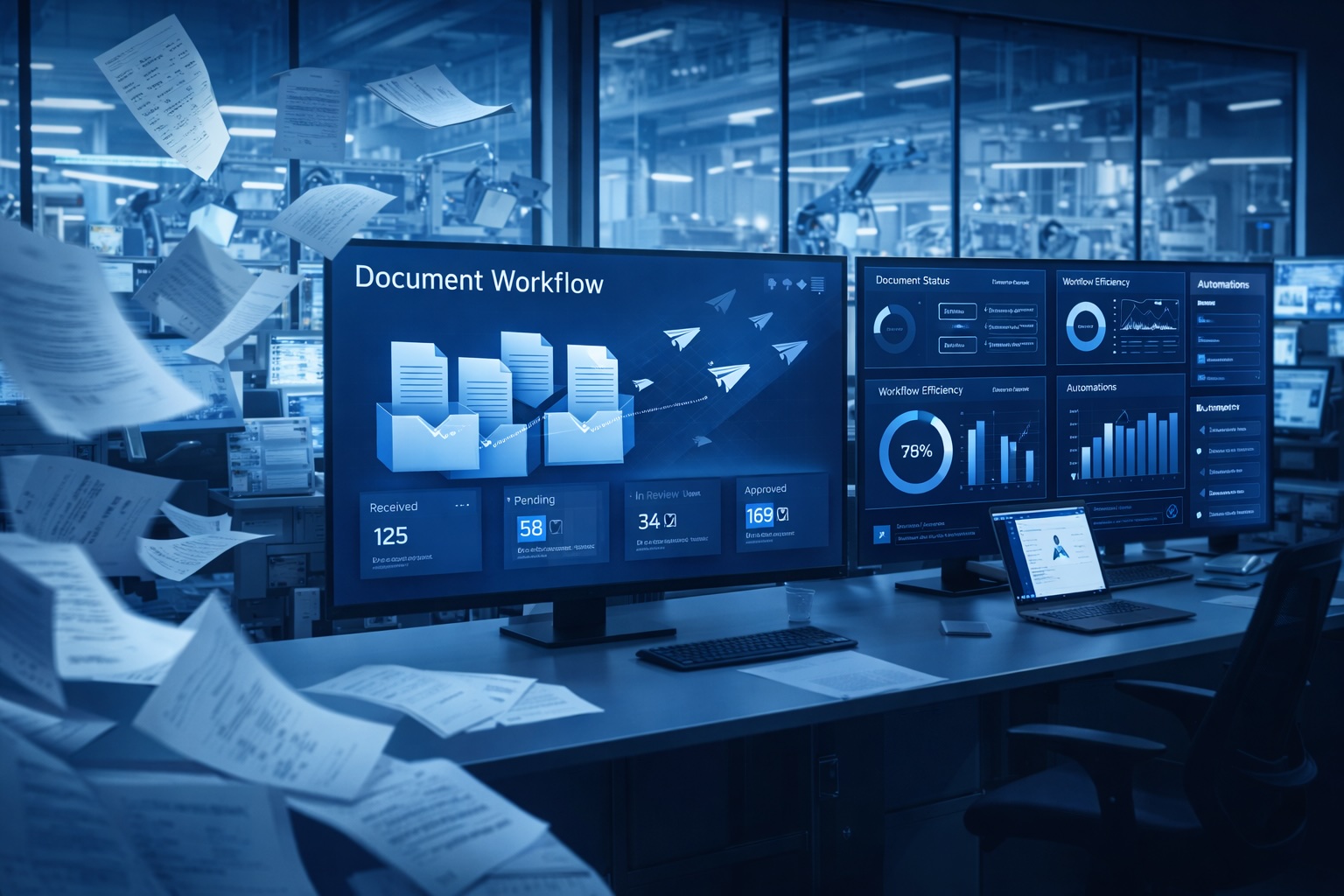
Real-time visibility. Dashboards show exactly where every invoice sits in the pipeline — who needs to approve it, whether it matches a PO, and when it will post to SAP.
Scaling Across the Organization
After the initial pilot proved successful, JBM expanded the DocQ deployment across additional plants and entities. The platform's multi-tenant architecture and configurable workflow engine made this straightforward — each plant could have its own approval rules, vendor hierarchies, and SAP integration mappings without requiring new development.
The same pipeline that handles invoices at one plant handles them at all of them. New plants are onboarded by configuring rules, not writing code.
Today, JBM Group's AP automation runs autonomously across their manufacturing network. Thousands of invoices flow through the pipeline monthly, each one classified, extracted, matched, approved, and posted without manual intervention. The finance team has been freed from the grind of data entry to focus on what actually matters: financial analysis, vendor relationships, and strategic planning.
As Lalit Kaushik, GM InfoSec at JBM Group, puts it: the ROI was unmistakable from year one. Processing time dropped by hundreds of hours monthly. Operational costs fell. And because the platform required no model training — just configuration — the time-to-value was measured in weeks, not quarters.