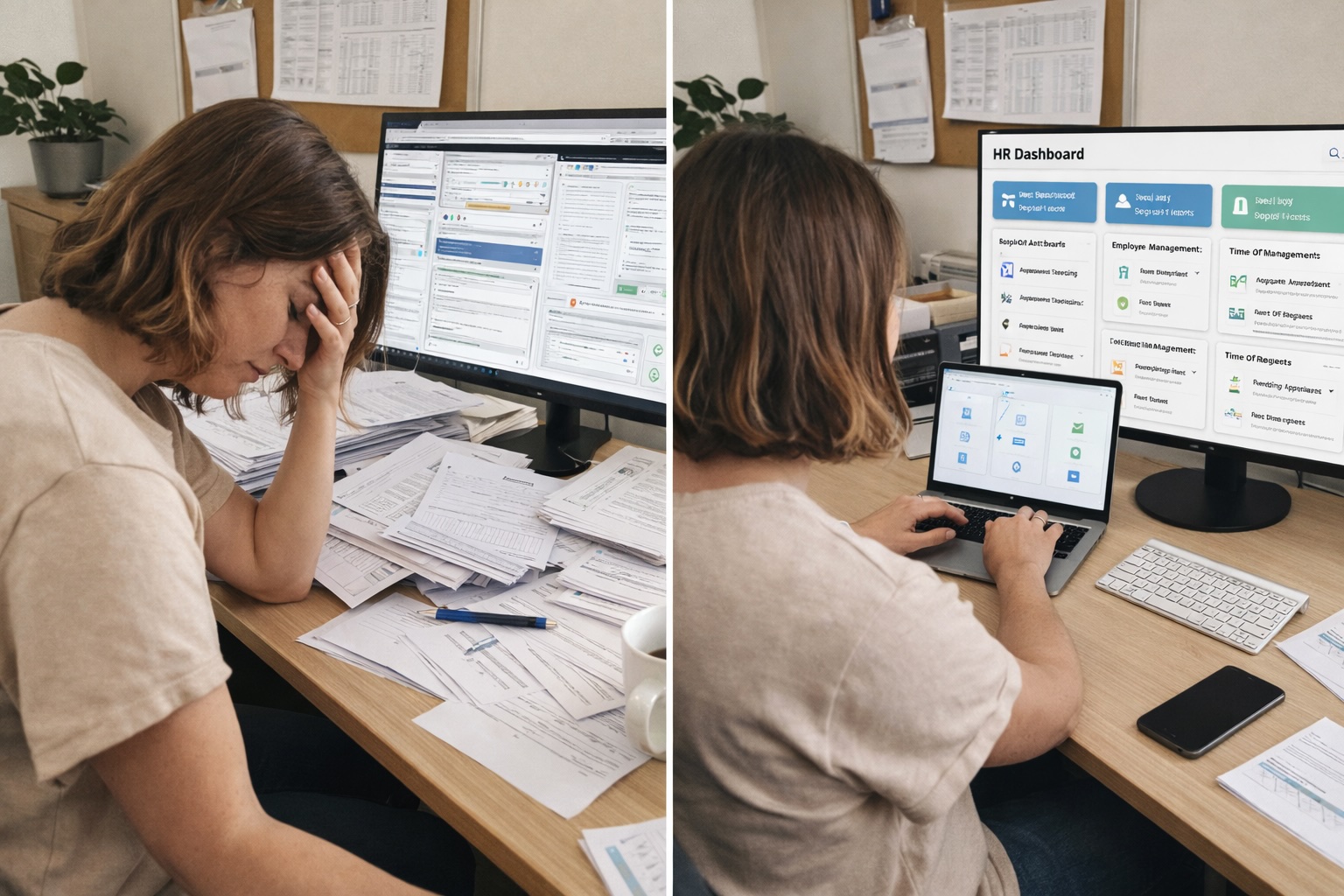
The Five-Hour Problem
Forbes research paints a stark picture: HR professionals spend 86% of their working hours on administrative tasks. That leaves roughly five hours per week — less than one hour per day — for the work that actually moves the needle: talent development, culture building, workforce planning, and employee engagement.
This isn't a staffing problem. It's a systems problem. And it persists because most organizations still rely on a patchwork of spreadsheets, email chains, paper forms, and disconnected software tools to manage their people operations.
Where the Time Goes
The administrative burden in HR isn't one giant task. It's hundreds of small, repetitive actions distributed across the day:
- Data entry across systems — typing the same employee information into payroll, benefits, HRIS, and compliance platforms because none of them talk to each other
- Document chasing — emailing forms, following up on signatures, tracking down missing paperwork, filing completed documents
- Manual routing — forwarding approval requests to managers, escalating exceptions, tracking who has signed off and who hasn't
- Compliance tracking — maintaining audit trails manually, verifying that every required form has been completed and stored correctly
- Reporting — pulling data from multiple sources, reconciling discrepancies, assembling spreadsheets for leadership
Each of these tasks is individually manageable. But multiplied across every employee, every process, and every compliance requirement, they consume the department.
The Fragmented Tech Stack Problem
Many HR departments have tried to solve this by adding tools. An ATS for recruiting. An HRIS for records. A separate platform for benefits enrollment. Another for performance reviews. A different one for learning management.
The result is a tech stack that creates as many problems as it solves. Each system stores its own version of employee data. Each requires its own login, its own training, its own maintenance. And the gaps between systems — the handoffs, the manual transfers, the reconciliation — are where time disappears.
HR is not an IT department. Asking people-focused professionals to manage a complex software ecosystem is a misallocation of talent that compounds the original problem.
What Automation Actually Looks Like
The fix isn't another point solution. It's an integration and automation layer that sits across existing tools and eliminates the manual work between them.
Effective HR automation handles:
- Document generation — creating offer letters, policy acknowledgments, separation agreements, and compliance forms from templates, pre-populated with the right data
- Workflow routing — automatically sending documents to the right person for review, approval, or signature based on configurable rules
- E-signatures — collecting legally binding signatures digitally, with a complete audit trail
- System integration — pushing data to payroll, benefits, and HRIS platforms automatically, eliminating duplicate entry
- Compliance tracking — maintaining a searchable record of every action, every signature, and every approval without manual filing
The key distinction is that this doesn't require technical expertise to set up or maintain. A no-code platform lets HR teams configure their own workflows through simple interfaces — no developers, no IT tickets, no months-long implementation projects.
From Two Weeks to Two Hours
A Boston-area hospital put this approach into practice with their new employee onboarding process. Previously, each new hire required 36 pages of paper forms, manually distributed, signed, collected, and filed. The process took two weeks from offer acceptance to day-one readiness.
After digitizing those forms and automating the workflow — field validation, automatic routing, integrated data distribution to payroll, benefits, and IT — the entire onboarding process collapsed from two weeks to two hours.
That's not a marginal improvement. That's an order-of-magnitude change in operational capacity. And it freed the HR team to spend onboarding time on what actually matters: welcoming new employees, answering questions, building relationships, and setting people up for success.
The Environmental Footnote
There's a secondary benefit worth noting. The United States discards roughly 400 million metric tons of paper annually, representing over $120 billion in waste. Every paper form that gets digitized, every document that moves through a workflow instead of a filing cabinet, contributes to reducing that footprint.
It's not the primary reason to automate HR processes. But it's a meaningful side effect of doing the right thing operationally.
Reclaiming the 86%
The administrative burden on HR isn't inevitable. It's the result of processes that were designed for a paper-based world and never properly updated. The technology to eliminate most of that burden exists today — and it doesn't require ripping out existing systems or hiring a development team.
The question for HR leaders isn't whether to automate. It's how much longer they can afford to spend 86% of their time on work that a well-configured platform can handle in seconds.